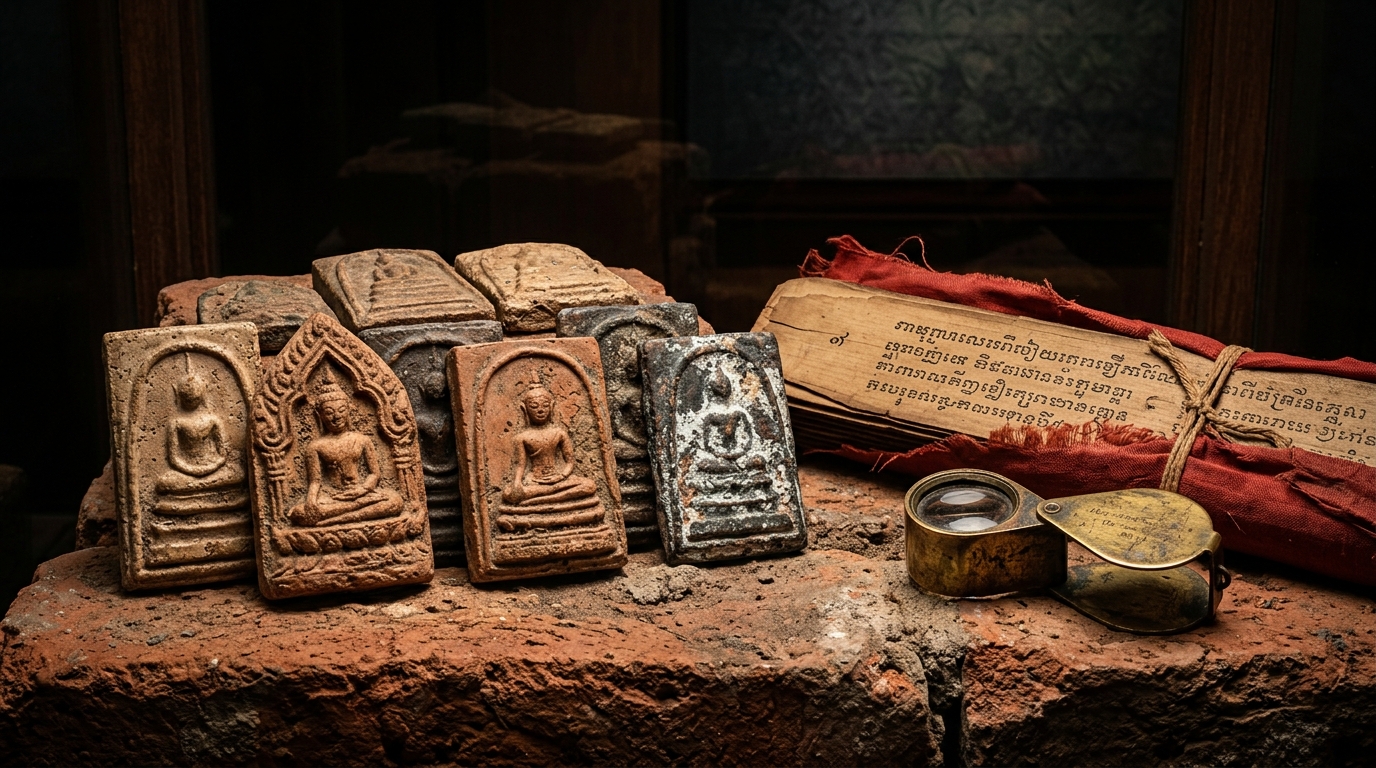
history15 min institutional reference
The Benjapakee (เบญจภาคี): Institutional Guide to the Grand Five Votive Tablets
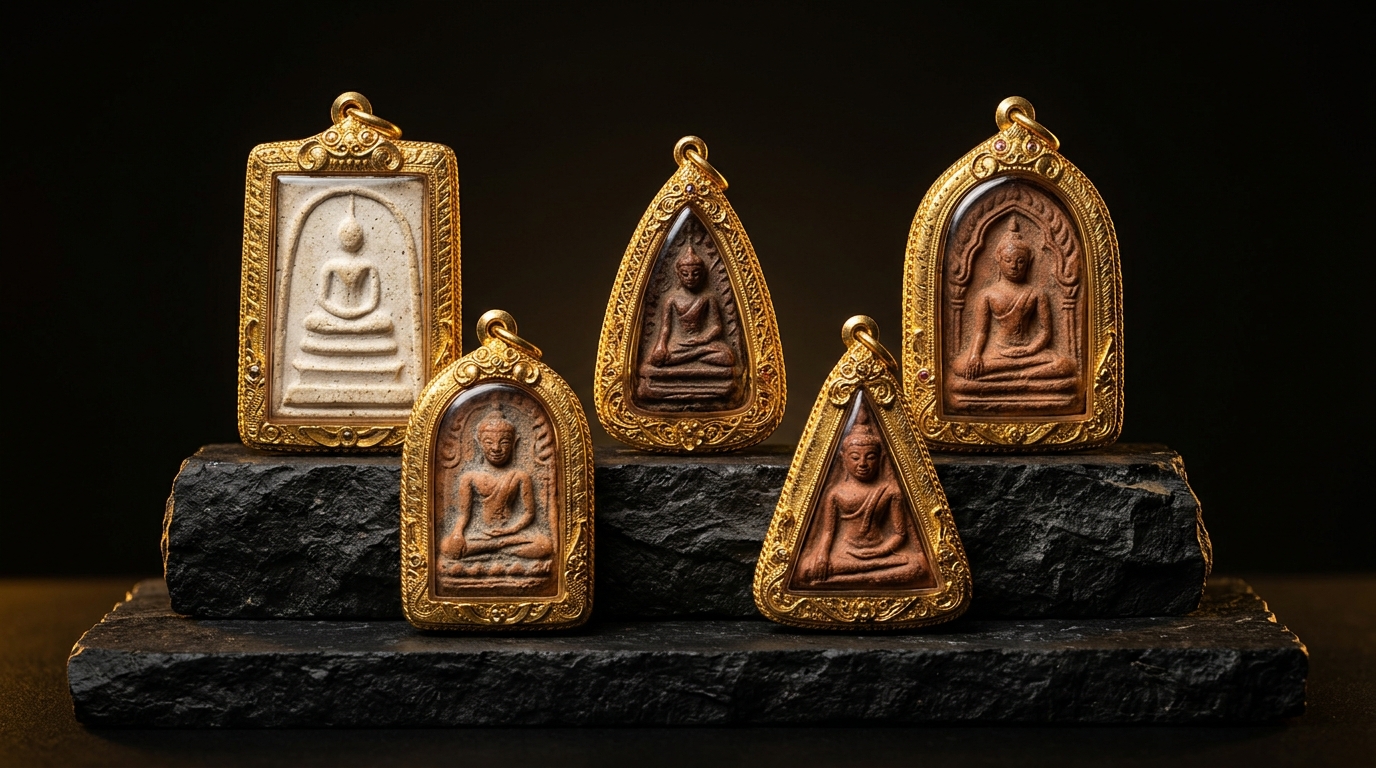
⚜ CANONICAL GRAND FIVE · CODIFIED BE 2495
⚜ Executive Reference Summary (EN)
Codified in BE 2495 by scholar Triyampawai, the Benjapakee unites five canonical votive tablets spanning 1,300 years of Siamese Buddhist art: Phra Somdej, Phra Rod, Phra Nang Phaya, Phra Phong Suphan, and Phra Sumkor.
Codified By
Col. Prayoon Ploywimon (Triyampawai) in BE 2495 (1952 CE)
Central Crown Piece
Phra Somdej (Wat Rakhang / Wat Bang Khun Phrom / Wat Ket Chaiyo)
Age Span
c. BE 1200 (Phra Rod) to BE 2415 (Phra Somdej)
Secondary Hierarchies
Benjapakee Rian (Top 5 Monk Coins) & Benjapakee Phra Pidta
1
1. Structural Composition of the Grand Five Pantheon
Each member of the Benjapakee represents a distinct historical kingdom, provincial crypt, and sculptural idiom.
Rather than overlapping in era, the five pieces span Hariphunchai (Phra Rod, Lamphun), U-Thong/Early Ayutthaya (Phra Phong Suphan, Suphan Buri), Sukhothai/Kamphaeng Phet (Phra Sumkor), Mid-Ayutthaya (Phra Nang Phaya, Phitsanulok), and Rattanakosin (Phra Somdej, Bangkok/Ang Thong).
2
2. Mould Taxonomy (Pim Niyom) & Forensic Hallmarks
- ◆Institutional appraisal of any Benjapakee specimen begins with exact mould identification (Pim) followed by material matrix verification: bamboo-cut edge drag marks and tung-oil shrinkage crazing on Phra Somdej
- ◆the
cockroach-bellybase fold (Kon Malaeng Sab) on Phra Rod - ◆protruding quartz grit with thermal contraction micro-cracks on Phra Nang Phaya
- ◆the ancient artisan's coarse thumbprint on the reverse of Phra Phong Suphan
- ◆crimson
tamarind-flowermineral flecks (Wan Dok Makham) on Phra Sumkor.
3
3. Phra Somdej & Phra Rod: The Rattanakosin Crown and Hariphunchai Antiquity
01
Phra Somdej (Wat Rakhang, Wat Bang Khun Phrom, Wat Ket Chaiyo — BE 2409–2415): Occupying the apex of the Benjapakee triad, Somdej Toh's rectangular chalk tablet represents the Buddhist Dharmachakra and Mount Meru in abstract architectural form. Forensic inspection focuses on the bell arch (Sum Korb Kaew), 3-tiered throne symmetry, bamboo-sliver edge slicing (Roi Tok Tat), and calcified tung-oil shrinkage networks.
02
Phra Rod (Wat Mahawan, Lamphun — c. BE 1200–1300): The oldest amulet in the pantheon, depicting the Buddha in Mara Vichai beneath a stylized Bodhi tree canopy (Pho Samrik). Diagnostic checkpoints include the fine waterfall robe fold under the left elbow, radiating Bodhi leaves, and the folded
cockroach-belly base (Kon Malaeng Sab) formed when pressing ultra-fine alluvial clay out of the ancient stone mould.4
4. Phra Nang Phaya, Phra Phong Suphan & Phra Sumkor: The Triangular & Arch Masterpieces
01
Phra Nang Phaya (Wat Nang Phaya, Phitsanulok — c. BE 2090–2106): Commissioned by Queen Wisutthikasat (mother of King Naresuan the Great), characterized by its triangular silhouette, regal broad shoulders, and coarse riverine clay studded with white and translucent quartz gravel (Raed Loi) that creates tiny surface contraction fissures during kiln firing.
02
Phra Phong Suphan (Wat Phra Si Rattana Mahathat, Suphan Buri — U-Thong Era, opened BE 2456): Recorded on a gold-leaf inscription plate attributing creation to hermit Rishi Pimpilalai, categorized into three facial aging moulds—Pim Na Kae (Old Face), Pim Na Klang (Middle Face), and Pim Na Num (Young Face)—always bearing the ancient artisan's whorl thumbprint on the reverse.
03
Phra Sumkor (Thung Setthi Crypts, Kamphaeng Phet — Sukhothai Era, opened BE 2392 by Somdej Toh): Molded in a distinctive
Kor-letter arch frame (Sum Kor) from waxy iron-rich herbal clay spotted with crimson tamarind-flower ferric oxide nodules (Raed Dok Makham) and black crypt lichen (Ra Dam).5
5. Extended Institutional Pentads: Benjapakee Rian (Monk Coins) & Benjapakee Phra Pidta
01
Benjapakee Rian Phra Geji (Top 5 Struck Monastic Medallions): Rian Luang Puเอี่ยม (LP Iam) Wat Nang BE 2467, Rian Luang Phor Khao Wat Khao Kwai BE 2460, Rian Luang Phor Kong Wat Bang Kapom BE 2484, Rian Luang Phor Chui Wat Kongkaram BE 2465, and Rian Luang Phor Suk Wat Pak Khlong Makham Thao BE 2466.
02
Benjapakee Phra Pidta Nuea Phong Kluk Rak (Top 5 Lacquer-Dipped Powder Pidta): Luang Phor Kaew Wat Kruawan, Luang Pu Eiam Wat Saphan Sung, Luang Pu Yim Wat Nong Bua, Luang Pu Khai Watเชิงเลน (Wat Cherng Len), and Luang Pu Jeen Wat Tha Lad.
Institutional Reference Comparison Matrix
| Rank & Name | Issuing Temple & Province | Era & Date | Material Matrix (Nuea) | Canonical Moulds (Pim Niyom) |
|---|---|---|---|---|
| 1. Phra Somdej (พระสมเด็จ) | Wat Rakhang, Wat Bang Khun Phrom, Wat Ket Chaiyo | Rattanakosin (BE 2409–2415) | 5 Sacred Chalk Powders + shell lime + tung oil | Pim Yai, Pim Chedi, Pim Than Sam, Pim Ket Bua Toom, Pim 7 Chan |
| 2. Phra Rod (พระรอด) | Wat Mahawan (Lamphun) | Hariphunchai (c. BE 1200–1300) | Ultra-fine kiln-fired alluvial clay | Pim Yai, Pim Klang, Pim Lek, Pim Tuen, Pim Tor |
| 3. Phra Nang Phaya (พระนางพญา) | Wat Nang Phaya (Phitsanulok) | Ayutthaya (c. BE 2090–2106) | Coarse baked clay with quartz grit | Pim Khao Khong, Pim Khao Trong, Pim Ok Nu, Pim Sanghati |
| 4. Phra Phong Suphan (พระผงสุพรรณ) | Wat Phra Si Rattana Mahathat (Suphan Buri) | U-Thong (c. BE 1800–1900; opened BE 2456) | Fine clay + 108 herbal pollens | Pim Na Kae (Old Face), Pim Na Klang, Pim Na Num |
| 5. Phra Sumkor (พระซุ้มกอ) | Thung Setthi Crypts (Kamphaeng Phet) | Sukhothai (c. BE 1900–2000; opened BE 2392) | Waxy iron-rich clay + herbal resin | Pim Yai Mee Kanok, Pim Yai Mai Mee Kanok, Pim Klang, Pim Lek |