
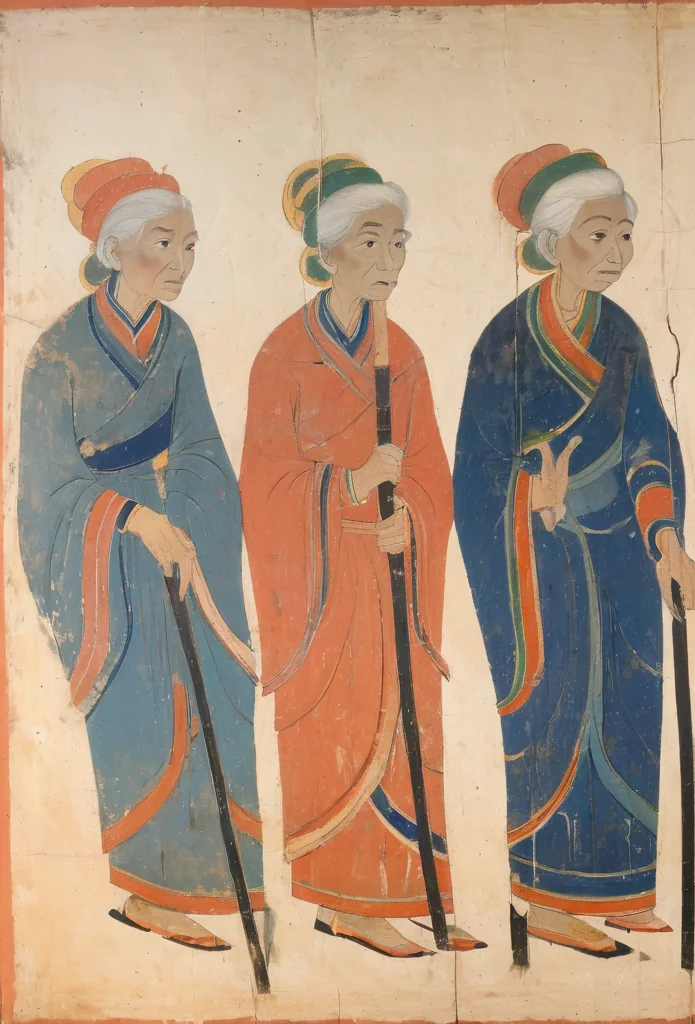
Luk Phaya Marn, literally "children of the lord Māra", is the heading under which this entry covers the three daughters of Māra, the figure Thai Wikipedia glosses as whatever "kills" a person's goodness or blocks a good outcome [6]. In Pali they are Taṇhā, Arati and Ragā [1]. Their main canonical episode is in the Saṃyutta Nikāya, where the three try to seduce the Buddha and fail [1]. Thai Buddha-biographies retell the story in more than one way, and at least one northern Thai temple mural paints the daughters as three old women [8].
Key facts
| Fact | Detail | Source |
|---|---|---|
| Canonical source | Māradhītusutta, "Māra's Daughters" (SN 4.25), in the Saṃyutta Nikāya | [1] |
| Pali names | Taṇhā, Arati, Ragā (translated by Bhikkhu Sujato as Craving, Malignancy and Lust) | [1] |
| Setting | Continues directly from SN 4.24, which is set at the goatherd's banyan tree at Uruvelā on the Nerañjarā River after seven years of pursuit by Māra (SN 4.25 states no setting of its own) | [1], [2] |
| Second canonical mention | Sutta Nipāta 4.9 (Māgaṇḍiyasutta), opening verse names the three (without the word "daughters") | [3] |
| Thai placement | Fifth week after awakening, under the Ajapāla banyan (อชปาลนิโครธ), as daughters of Thao Wasawatti (ท้าววสวัตตี) | [7], [8] |
| Mural example | Wat Luang Ratchasanthan (วัดหลวงราชสัณฐาน), Phayao: three old women walking away from the principal image | [8] |
Name and meaning
The Thai phrase has three parts. Luk (ลูก) is the ordinary word for a child, someone born of parents [10]. Phaya (พญา) means a chief or head, and is often placed before another noun, as in phaya nak (พญานาค) [9]. Marn (มาร) is the Thai form of Māra, a word Thai Wikipedia traces to the Pali root mar, "to die" [6]. Put together, the words can be read as "children of the chief Māra". This reading is our own gloss of the parts; the sources do not attest ลูกพญามาร as an established term. In the scripture the word used is māradhītaro, "Māra's daughters" [1].
Thai Buddhist teaching recognises several kinds of Māra. Thai Wikipedia, following the Visuddhimagga, lists five. One is the "deva-son Māra" (เทวปุตตมาร), exemplified by Thao Wasawatti, chief of the Paranimmitavasavatti heaven [6]. Thai Wikipedia's account of the fifth week names Thao Wasawatti as the father of the three daughters [7]; the Pali sutta itself calls their father only Māra the Wicked [1].
Scriptural source
The episode is the Māradhītusutta of the Saṃyutta Nikāya, numbered SN 4.25 [1]. It continues directly from SN 4.24, "Seven Years of Pursuit". That sutta is set at Uruvelā, at the goatherd's banyan tree (Pali ajapālanigrodha) on the bank of the Nerañjarā River. It records that Māra had followed the Buddha for seven years, looking for a weakness and finding none [2]. SN 4.25 opens as Māra, having spoken his verses of disappointment, leaves the Buddha's presence [1].
The same three names appear in the Sutta Nipāta. In the opening verse of the Māgaṇḍiyasutta (Snp 4.9), the Buddha says that even when he saw Taṇhā, Arati and Ragā (Craving, Malignancy and Lust) he had no desire for sex [3]. The verse itself does not call them Māra's daughters.
The episode
In SN 4.25 the daughters find their father downcast and ask what man he is upset about. They offer to catch the man "with the snare of lust" [1]. Māra replies that the Buddha is a perfected one who is not easily seduced and has slipped free of his dominion [1].
The daughters go to the Buddha and offer to serve at his feet. He pays no attention, because he is freed by the ending of attachments. They then try again, each taking the form of a hundred women at a time. The sutta lists six stages: young maidens, women who had never given birth, women who had given birth once, women who had given birth twice, middle-aged women and old women. Each time the Buddha ignores them [1].
The daughters admit their father was right. Next, each one addresses the Buddha in verse, and he answers each in turn [1]. When they go back, Māra mocks them with images of useless effort, such as drilling into a mountain with lotus stalks. The sutta closes by comparing the Teacher brushing them off to a gale scattering a fallen tuft [1].
The three names
- Taṇhā (ตัณหา). The Pali Text Society dictionary gives the literal sense as "drought, thirst" and the figurative sense as craving or "the fever of unsatisfied longing" [4].
- Arati (อรดี). The same dictionary defines arati as "dislike, discontent, aversion", from the negative prefix a- and rati [4]. Sujato's translation of SN 4.25 renders the daughter's name as "Malignancy" [1].
- Ragā (ราคา). The dictionary treats Ragā as a variant reading of rāga, whose moral sense is "excitement, passion". It notes that when personified, Rāga, Taṇhā and Arati are called the daughters of Māra. It cites Snp 835, the Dhammapada commentary and the Mahāniddesa [5].
The Thai spellings follow the Lanna Buddha-biography Sambhāravipāka (สัมภารวิบาก), as quoted in a 2020 study from a modern Thai translation (Phra Dhammamahaviranuvat, early 1960s). That translation names them นางราคา, นางอรดี and นางตัณหา [8].
In Thai art and literature
Thai Wikipedia's list of the seven places where the Buddha stayed after the awakening puts the temptation in the fifth week, under the Ajapāla banyan, where the three daughters of Thao Wasawatti tried to entice him and failed [7]. The 2020 study below reports the same week-five placement in the Jinamahānidāna and Pathomsomphot [8]. BuddhaNet's illustrated "Life of Lord Buddha" mural series also has a panel called "The Daughters of Mara", set during the Buddha's seven days under the banyan [11].
Thai literature does not always tell the story the same way. A 2020 article in the Journal of Humanities, Naresuan University compared eight Buddha-biographies, and found the following [8]:
- Among the three Theravāda texts the study analyses in detail, only the Sambhāravipāka tells of the daughters becoming old women, as the result of their own karma for tempting the Bodhisatta.
- The Sambhāravipāka places the temptation before Māra's assault on the Bodhisatta, so before the awakening.
- The Jinamahānidāna and the Pathomsomphot (ปฐมสมโพธิกถา) do not include this version.
- The study reports that in the Lalitavistara's account of the fourth week after the awakening, the daughters take the forms of women of various ages and are then turned into old women [8]. (Its summary of the Lalitavistara's pre-awakening scene has no old-women episode.)
The study's case is a mural behind the principal Buddha image in the vihara of Wat Luang Ratchasanthan in Phayao [8]. Citing earlier research, it dates the murals to the 23rd Buddhist century [8]. Instead of the familiar Māravijaya scene with the earth goddess wringing out her hair, this wall shows Māra's army advancing on one side and paying homage on the other [8]. Among the attacking army are three hunched old women with walking sticks. They face away from the principal image and walk against the direction of the advance. The author identifies them as Māra's daughters, painted according to the Sambhāravipāka [8].
The subject also appears elsewhere in mainland Southeast Asia. The Victoria and Albert Museum holds a 15th-century glazed earthenware plaque, possibly from the Shwegugyi pagoda in Pegu (Bago), Burma. It shows two of Māra's daughters holding fans, and probably belonged to a series on the defeat of Māra's army [12].
As an amulet motif
For this entry we could not find an independent, reputable source, such as a newspaper report, museum record or academic study, that documents amulets made under the name Luk Phaya Marn: their makers, release dates, standard forms or materials. For that reason this entry names no makers and gives no typical designs. The textual and mural sources above are the only verified record of how the three figures are described and shown.
When the Exchange catalogues a piece sold under this name, it records only what can be checked on the object and its paperwork: the form (pendant, cloth, metal, perfume or other), the stated maker and temple, the stated year, the materials, and any inscriptions. Dealer descriptions of what such pieces are said to do are not part of the catalogue record.
Related terms
- Māra / Phaya Marn (มาร, พญามาร): the figure who tempts and obstructs; the 2020 study writes the title as พระยามาร / พญามาร [8]. Thai Wikipedia names Thao Wasawatti as the example of the "deva-son Māra" [6] and as the father of the three daughters [7].
- Māradhītusutta (SN 4.25): the canonical source of the episode [1].
- Māravijaya / Mara Phachon (มารผจญ): the assault of Māra's army, a separate scene that some texts link to the daughters' temptation [8].
- Ajapāla banyan (อชปาลนิโครธ): the goatherd's banyan, where SN 4.24 is set (SN 4.25 continues it) and where Thai Wikipedia's seven-weeks account places the daughters' temptation [2], [7]; the Sambhāravipāka instead places it before the awakening [8].
- Sambhāravipāka (สัมภารวิบาก): the Lanna Buddha-biography in which the daughters become old women [8].
Where to see pieces like this — Our sister shop, Shogun X Amulets, has published an article on Luk Phaya Marn: https://shogunxamulets.com/three-names-that-represent-desire-luk-phaya-marn/. Disclosure: Shogun X Amulets and ThaiAmuletExchange.com are run by the same group.