
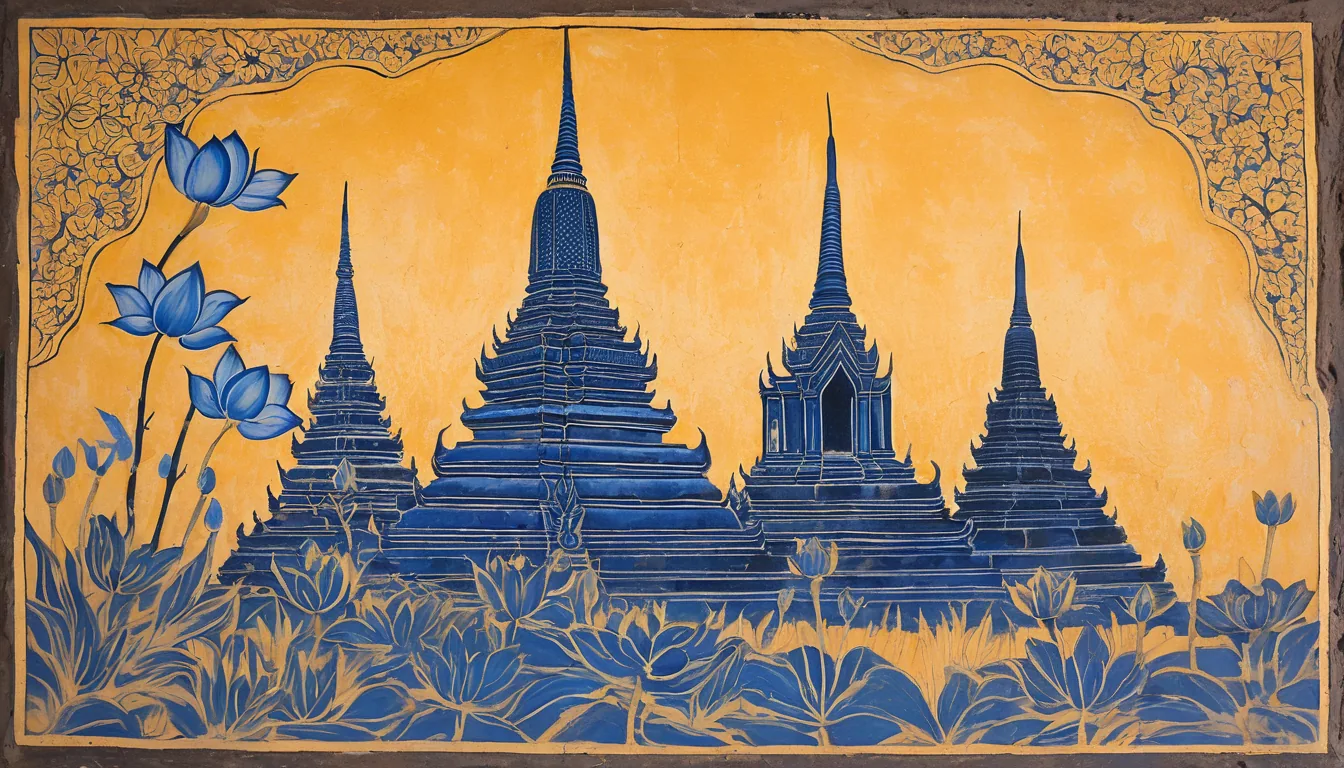
Phra Sumkor—also romanized Phra Sum Kor or Phra Kamphaeng Sum Kor (Thai: พระซุ้มกอ / พระกำแพงซุ้มกอ; Chinese: 帕颂扣 / 颂扣佛)—is a Sukhothai-era votive tablet recovered from ruined fourteenth-century stupas across the Thung Setthi (ลานทุ่งเศรษฐี) plain in Nakhon Chum on the western bank of the Ping River in Kamphaeng Phet province [1], [3], [9]. Molded in a curved thumbnail silhouette (รูปทรงเล็บมือ) whose radiating aura arch resembles the Thai consonant Kor Kai (ก), the tablet represents the Sukhothai–Kamphaeng Phet sculptural school inside Thailand's five-piece Benjapakee (เบญจภาคี) canon [1], [10], [16]. First documented during Somdej Phra Buddhacarya (Toh Phrommarangsi)'s BE 2392 (1849 CE) expedition to Wat Phra Borommathat Nakhon Chum, it is associated in Thai epigraphic lore with the silver-plate maxim "Mung mi ku wai mai chon" (มึงมีกูไว้ไม่จน, "Whoever possesses me shall never be poor") [4], [8], [11], [17].
Key facts
| Fact | Detail | Source |
|---|---|---|
| Thai and Chinese names | พระกำแพงซุ้มกอ / พระซุ้มกอ (Phra Kamphaeng Sum Kor / Phra Sumkor); 帕颂扣 | [1], [7], [8] |
| Origin site | Stupas of the Thung Setthi ("Millionaire's Field") zone, Nakhon Chum subdistrict, Mueang Kamphaeng Phet district | [1], [2], [9] |
| Historical period | Sukhothai kingdom (mid-14th century, linked to King Maha Thammaracha I Lithai's BE 1900 / 1357 CE relic consecration) | [3], [4], [7] |
| First recorded opening | BE 2392 (1849 CE) at Wat Phra Borommathat Nakhon Chum, followed by excavations in 1871–1906, 1947, 1958, 1962, and 1966 | [1], [4], [11], [17] |
| Etymology | Thumbnail-shaped frame (ทรงเล็บมือ) with a curved halo arch shaped like the Thai letter Kor Kai (ก) |
[1], [9], [12] |
| Five standard moulds | Phim Yai Mi Kanok, Phim Yai Mai Mi Kanok (Sum Kor Dam), Phim Klang, Phim Lek (Phat Bai Lan), and Phim Khanom Pia | [1], [7], [12], [15] |
| Primary materials | Fine baked terracotta mixed with sacred wan herbs and pollen, plus rarer lead-tin pewter (เนื้อชินเงิน / ตะกั่ว) casts | [1], [7], [9] |
| Canon status | Selected in BE 2495 (1952 CE) by Col. Prayoon Kittiprawat (Triyampawai) as the Sukhothai representative in the Benjapakee set | [8], [11], [16] |
Nakhon Chum, Thung Setthi, and the Sukhothai royal chronicle
To understand Kamphaeng Phet amulet hoards, one must examine the twin-city geography of the middle Ping River valley [3], [5], [6]. During the Sukhothai period, two fortified settlements faced each other across the river: Chakangrao (modern Mueang Kamphaeng Phet) on the eastern bank and Nakhon Chum on the western bank, where Khlong Suan Mak joins the Ping River [3], [4], [6]. In 1991, UNESCO inscribed Kamphaeng Phet Historical Park alongside Sukhothai and Si Satchanalai as a World Heritage Site [5], [6].
The historical anchor for Nakhon Chum is Stone Inscription No. 3 (the Nakhon Chum Inscription, dated BE 1900 / 1357 CE) [3], [4], [7]. It records that King Maha Thammaracha I (Phraya Lithai) traveled to Nakhon Chum in BE 1900 to enshrine a sacred relic of the Buddha (พระบรมสารีริกธาตุ) from Sri Lanka inside the principal stupa of Wat Phra Borommathat Nakhon Chum and to plant a sacred Bodhi tree nearby [3], [4], [7]. Across the plain west and south of Wat Phra Borommathat—known as Lan Thung Setthi (ลานทุ่งเศรษฐี, "Millionaire's Field")—Sukhothai rulers and monastic communities erected dozens of brick and laterite monasteries, including Wat Phikun Thong, Wat Ruesi, Wat Nong Langka, Wat Noi, and Wat Sum Kor [1], [2], [9], [11].
Fine Arts Department surveys at Wat Sum Kor (วัดซุ้มกอ), about 500 meters south of the southern Nakhon Chum city moat, document an octagonal laterite chedi base measuring 12 by 12 meters supporting a bell-shaped brick superstructure [2]. Inside the sealed relic chambers (กรุ) of these Thung Setthi stupas, fourteenth-century artisans deposited thousands of clay and pewter votive tablets alongside inscribed silver sheets [1], [7], [11].
The 1849 (BE 2392) discovery by Somdej Toh and later excavations
According to research in the Ubon Ratchathani University Journal of Liberal Arts, Wat Phra Borommathat Nakhon Chum was abandoned around BE 2127 (1584 CE) and remained overgrown for more than two centuries [4]. Its rediscovery began in BE 2392 (1849 CE), late in the reign of King Rama III [4], [11], [17].
In that year, Somdej Phra Buddhacarya (Toh Phrommarangsi)—then Phra Thep Kawi of Wat Rakhang Khositaram—traveled north by boat to visit relatives in Kamphaeng Phet [9], [11], [17]. He read an ancient stone inscription at Wat Sadet describing three ruined reliquary chedis along Khlong Suan Mak on the Nakhon Chum bank [9], [10], [11]. Clearing the jungle at Wat Phra Borommathat, his party located the crumbling stupas and uncovered sealed crypts containing Phra Sumkor, Phra Med Khanun, and Phra Phluang tablets along with silver inscription plates (จารึกลานเงิน) [9], [11], [17].
Somdej Toh transcribed the formulas from those silver plates and brought sacks of damaged Kamphaeng Phet clay tablet fragments and stupa brick crumbs back to Bangkok [11], [14], [17]. When he created his white Phra Somdej Wat Rakhang tablets in the 1860s, those pulverized Kamphaeng Phet fragments (ผงพระกำแพงหัก) formed a primary sacred ingredient in the shell-lime paste [11], [14], [17].
Over the following century, three major excavation phases brought more Phra Sumkor tablets to light:
- BE 2414–2449 (1871–1906 CE) chedi reconstruction: Karen timber merchants Sa Pho and Pha Po (พะโป้) received permission to consolidate and rebuild the ruined Nakhon Chum stupas into a single Mon-Burmese style pagoda at Wat Phra Borommathat, uncovering further tablet deposits [4], [9], [10], [11].
- BE 2490 (1947 CE) and BE 2501 (1958 CE) crypt openings: Post-war digs across Wat Phikun, Wat Ruesi, and Wat Nong Langka yielded additional clay and pewter tablets [1], [11].
- BE 2505 (1962 CE) and BE 2509 (1966 CE) Fine Arts Department surveys: Official archaeological clearances at Wat Sum Kor and neighboring mounds recovered specimens now housed in the Kamphaeng Phet National Museum [1], [2], [11].
Meaning of the name Phra Sum Kor and the silver-plate maxim
The name Phra Sum Kor (พระซุ้มกอ) describes the distinctive frame of the tablet [1], [8], [9]. Phra Sumkor has a rounded arch-topped outline resembling a human thumbnail (รูปทรงเล็บมือ) [1], [9], [12]. Framing the seated Buddha is a raised curving moulding (ซุ้มประภามณฑล) whose arched silhouette mirrors the first Thai consonant, Kor Kai (ก) [1], [10], [12]. Collectors combined sum (ซุ้ม, arch) with Kor (กอ, the letter ก) to coin Phra Sum Kor [1], [8], [9].
The amulet is equally famous for a short maxim recorded in the Nakhon Chum silver inscription plates: "Mung mi ku wai mai chon" (มึงมีกูไว้ไม่จน, or มีกูแล้วไม่จน, meaning "If you possess me, you will never be destitute") [7], [8], [11], [16]. As reported by Thairath, Kom Chad Luek, and the Kamphaeng Phet National Museum, the inscription text narrated how four forest ascetics (ฤๅษี)—Phra Ruesi Phimphilalai, Ruesi Ta Fai, Ruesi Ta Wua, and Ruesi Kalaikot—blended medicinal herbs (ว่านยา), pollen, and mineral earth to consecrate the tablets [1], [7], [8], [11].
The five standard moulds (พิมพ์) of Phra Sumkor
Specialists and the Fine Arts Department classify authentic Phra Sumkor tablets into five standard moulds based on size, background ornament, and rim contour [1], [7], [12], [15]. In all five moulds, the Buddha sits in deep meditation (ปางสมาธิ) over a double-tiered lotus throne (ฐานบัวสองชั้น), with the torso displaying the fluid, sinuous shoulders and slender waist characteristic of Sukhothai-Lanna-Sri Lankan sculptural synthesis [1], [9], [12].
| Mould name | Thai script | Key visual traits | Typical material | Source |
|---|---|---|---|---|
| 1. Phim Yai Mi Kanok | พิมพ์ใหญ่มีกนก | Deep relief, three flame-like kanok scrolls flanking the halo, 5 elephant-nail lotus petals on base | Fired clay (red, yellow, green-black) and rare pewter | [1], [7], [10], [12] |
| 2. Phim Yai Mai Mi Kanok | พิมพ์ใหญ่ไม่มีกนก | Same large frame as Phim Yai but plain background without kanok scrolls; often called Sum Kor Dam | Primarily black or dark brown clay | [1], [7], [9], [12] |
| 3. Phim Klang | พิมพ์กลาง | Slightly smaller and shallower relief than Phim Yai Mi Kanok, retains kanok motifs | Fired clay and lead-tin pewter (เนื้อชิน) | [1], [7], [9] |
| 4. Phim Lek (Phat Bai Lan) | พิมพ์เล็ก / พัดใบลาน | Compact narrow silhouette tapering toward the base like a monastic palm-leaf fan | Fired clay | [1], [7], [12], [15] |
| 5. Phim Khanom Pia | พิมพ์ขนมเปี๊ยะ | Rounded circular or oval outline where the excess clay flange was left untrimmed around the arch | Fired clay | [1], [7], [12], [15] |
1. Phim Yai Mi Kanok (พิมพ์ใหญ่มีกนก — Large Mould with Kanok)
Phim Yai Mi Kanok is the flagship mould of the series and commands the highest valuations in Thai collecting [7], [10], [12]. The Buddha sits in meditation atop a double lotus pedestal whose upper row forms five distinct rounded petals known as bua lep chang (บัวเล็บช้าง, "elephant-nail lotus petals") above a horizontal beaded or recessed base line [1], [10], [12]. Inside the recessed Kor Kai arch, stylized flame or vine scrolls (ลายกนก) rise on both sides of the Buddha's halo—traditionally read as three kanok curls on the viewer's left and a matching scroll pattern on the right [1], [10], [12].
2. Phim Yai Mai Mi Kanok (พิมพ์ใหญ่ไม่มีกนก — Large Mould without Kanok / Sum Kor Dam)
Pressed in a large thumbnail frame of comparable height and width, Phim Yai Mai Mi Kanok omits the background kanok flame scrolls, leaving a smooth recessed field around the torso and head [1], [7], [9]. Because the majority of surviving examples from this mould were fired in a heavy reduction atmosphere that turned the herbal clay jet-black or dark charcoal-brown, Thai collectors commonly call this variety Phra Sum Kor Dam (พระซุ้มกอดำ, "Black Sum Kor") [1], [7], [12].
3. Phim Klang (พิมพ์กลาง — Medium Mould)
Phim Klang reproduces the full iconographic layout of Phim Yai Mi Kanok—including the flanking kanok scrolls and lotus throne—on a slightly smaller scale with noticeably shallower relief (ตื้นกว่าพิมพ์ใหญ่) [1], [7], [9]. Along with terracotta examples, a significant proportion of authentic lead-tin pewter (เนื้อชินเงิน) Phra Sumkor tablets belong to Phim Klang [1], [7], [9].
4. Phim Lek or Phim Phat Bai Lan (พิมพ์เล็ก / พิมพ์พัดใบลาน — Small Mould)
Phim Lek is the smallest of the trimmed moulds [1], [7], [12]. Because its lower edges curve inward toward the base rather than dropping vertically, the silhouette resembles an oval monastic palm-leaf fan (พัดใบลาน), earning it the alternate name Phim Phat Bai Lan [1], [12].
5. Phim Khanom Pia (พิมพ์ขนมเปี๊ยะ — Pastry Mould)
Whereas the first four moulds had their surrounding clay flash trimmed into a thumbnail arch with a bamboo sliver or knife, Phim Khanom Pia was left with an untrimmed circular or cushion-shaped border resembling a Chinese flaky mooncake or pastry (ขนมเปี๊ยะ) [1], [7], [12], [15]. Despite the rounded exterior rim, the central impression inside the mould comes from the same Sukhothai die family [1], [12].
Kamphaeng Phet clay texture (เนื้อดินกำแพง) and crypt patina
The Fine Arts Department and veteran specialists emphasize that authentic Thung Setthi tablets can be identified by the distinctive physical chemistry of Kamphaeng Phet alluvial clay [1], [7], [9], [10]. Filtered free of coarse quartz grit and kneaded with crushed botanical matter, the fired terracotta feels fine, dense, and slightly waxy or velvety (เนื้อละเอียดหนึกนุ่ม) against the skin [7], [9], [10].
Under magnification, three natural mineral and biological markers distinguish six-hundred-year-old Thung Setthi clay from modern kiln reproductions [7], [9], [10]:
- Wan dok makham (ว่านดอกมะขาม): Minute reddish-orange and rust-colored mineral-herbal specks distributed unevenly beneath the fired surface skin [7], [9], [10].
- Ra dam or rarak (ราดำ / รารัก): Microscopic black dendritic spots of ancient crypt fungus that grew inside the damp laterite and brick chambers over centuries, penetrating into the pores of the clay [7], [9], [10].
- Khon pet (ขนเพชร) and nuan kru (นวลกรุ): A delicate whitish-grey calcitic efflorescence or soil bloom rising from the interior of the clay after prolonged burial in groundwater-fed stupa vaults [9], [10].
The back of a Phra Sumkor is typically flat to slightly convex with organic finger depressions and vertical wood-grain or wipe creases (หลังกาบหมาก), while the side edges show clean single-stroke trim marks made while the clay was leather-hard [9], [10], [12].
How Phra Sumkor replaced Phra Med Khanun in the Benjapakee
A notable historical detail documented by Thairath and Kom Chad Luek is that Phra Sumkor was not the first Kamphaeng Phet amulet chosen for Thailand's national five-amulet set [8], [10], [11], [12]. When Col. Prayoon Kittiprawat (Triyampawai) first expanded his three-amulet Traiphakhi in the early 1950s (BE 2495 / 1952 CE) to include a representative of the Sukhothai–Kamphaeng Phet school, many senior collectors initially favored Phra Kamphaeng Med Khanun (พระกำแพงเม็ดขนุน), an almond-shaped tablet depicting the walking or standing Buddha [8], [10], [11], [16].
However, when collectors mounted the five amulets together on a single neck chain or display tray, the tall standing figure of Phra Med Khanun disrupted the visual symmetry (ความสมดุล) of the ensemble, because the other four amulets—Phra Somdej Wat Rakhang, Phra Nang Phaya, Phra Phong Suphan, and Phra Rod—all depicted the Buddha in a seated posture [8], [10], [11], [12]. Because Phra Sumkor came from the exact same Thung Setthi crypts, carried identical Kamphaeng Phet clay and epigraphic provenance, and portrayed the seated Buddha in a harmonious thumbnail frame, Triyampawai and the collector community elevated Phra Sumkor into the permanent Benjapakee canon [8], [10], [11], [12].
On 20 June 2004, Thailand Post honored this status by featuring Phra Sumkor on its 9-baht Benjapakee commemorative postage stamp series (1,500,000 sets printed) [18].
Famous specimens (Ong Chao Ngo) and recorded market prices
Because intact Phim Yai Mi Kanok tablets with crisp facial details and undamaged arches are exceedingly scarce, museum-grade Phra Sumkor amulets rank among the highest-valued antiquities in Southeast Asia [7], [10], [13], [16].
The single most famous specimen in Thai amulet history is Ong Chao Ngo (องค์เจ้าเงาะ, "The Ngo Pa Prince Specimen"), a Phim Yai Mi Kanok tablet from the Thung Setthi crypt [8], [10], [11], [12], [13]. As chronicled by Kom Chad Luek, Thairath, and Daily News, the tablet was excavated by Kamphaeng Phet local Chian Thirasan entirely encrusted in thick black crypt fungus (คราบราดำจับหนา) that concealed its inner surface [10], [11], [12]. Over successive cleanings—reported as eleven careful washes in collector memoirs—the black crust dissolved to reveal a brilliant brick-red terracotta body of exceptional sharpness underneath, prompting collectors to name the amulet after Chao Ngo (the folk hero Sang Thong, who hid a golden body beneath an ugly dark mask) [8], [10], [11], [12]. In the 1980s, collector Niyom Asuni Na Ayutthaya acquired Ong Chao Ngo for 1,050,000 baht; in April 2013, Kom Chad Luek reported that the tablet was subsequently sold to Hong Kong collector Lai Kot Win for 50 million baht (approximately USD 1.6 million at the time) [10], [11], [12], [13].
More recently, in May 2025, Thairath reported a verified Phim Klang Phra Kamphaeng Sum Kor specimen trading at 2.5 million baht, illustrating the price tier between medium-mould tablets and championship Phim Yai Mi Kanok pieces [7]. Readers tracking current auction and dealer benchmarks across Thai amulet series can also consult observed listing prices.