
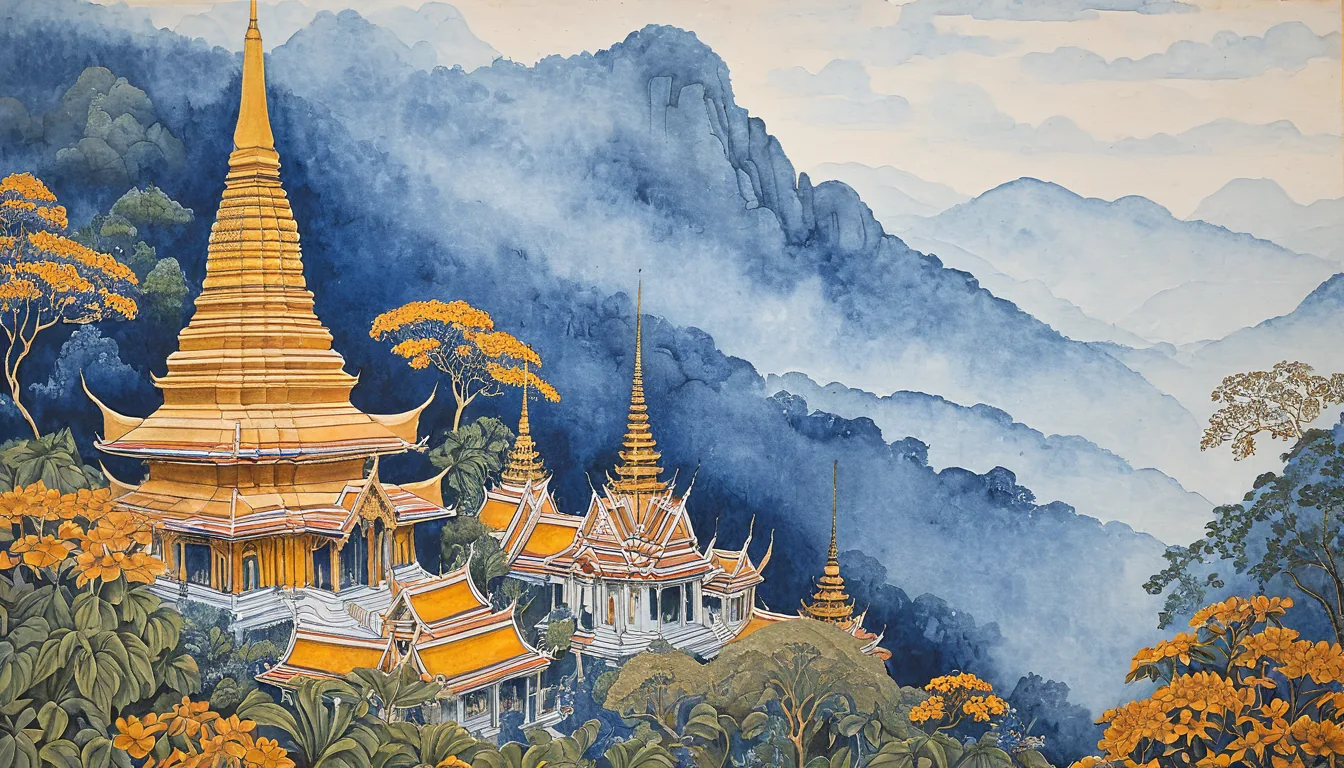
Kruba Srivichai (11 June 1878 - 20/21 February 1939; 2421 - 2481 BE), monastic name Siriwichayo and widely romanized in academic literature as Khruba Siwichai, was the most influential Lanna monk of modern northern Thailand [1][2][5]. Revered across the former Lanna kingdom as the Ton Bun ("Meritorious One" or "Saint of Lanna"), he mobilized tens of thousands of lowland Tai Yuan and highland Karen, Shan, and Hmong devotees to restore more than one hundred temples, copy thousands of palm-leaf manuscripts, and construct the eleven-to-twelve-kilometer Doi Suthep road in Chiang Mai between November 1934 and April 1935 without state funding [1][2][4][14]. At the same time, his adherence to traditional northern monastic autonomy (rabop hua muat wat) brought him into repeated conflict with Bangkok's centralized sangha administration under the Sangha Act of 1902, resulting in multiple ecclesiastic investigations and two periods of detention in Bangkok (1920 and 1935-1936) [2][6][11].
Early life in Ban Pang and monastic ordination
Kruba Srivichai was born at dusk on Tuesday, 11 June 1878 (the 11th waxing day of the 9th northern lunar month, Year of the Tiger, 2421 BE) in the mountain village of Ban Pang, Tambon Mae Tuen (now Tambon Srivichai), Li District, Lamphun Province [2][4][12]. He was one of five children born to Nai Khwai and Nang Usa, a farming couple from Ban San Pa Yang Luang who had migrated to clear land in Li District alongside Karen (Pgaz K'nyau) communities [11][12][14]. His paternal great-grandfather, Muen Prap, had served as a royal elephant catcher for Chao Daradirekratphairot, the seventh ruler of Lamphun [2][11].
According to Singkha Wannasai's biography San Prawat Kruba Chao Srivichai, a thunderstorm broke over the bamboo hut as Nang Usa gave birth, shaking the ground with thunder and heavy rain that stopped as the infant cried [2][12]. Villagers consequently named the boy Ai Fa Rong ("Thunder Boy") or In Fuean / Fuean ("Earth-Shaking") [2][4][11][14]. Growing up in a remote hamlet that lacked a village monastery, he helped his parents tend fields while refraining from fishing or harming animals [4][10][14].
When Fuean was seventeen, a wandering monk named Kruba Khattiya passed through Ban Pang from Ban Pa Sang, and villagers built a bamboo shelter for him [2][14]. At age eighteen (1896 / 2439 BE), Fuean ordained as a novice (samanera) under Kruba Khattiya at Wat Ban Pang, learning Lanna Tham script (Tua Mueang) and Pali [2][4][10]. Three years later, in 1899 (2442 BE; age 20 or 21 by northern count), he received higher bhikkhu ordination (upasampada) at Wat Ban Hong Luang in Ban Hong District, Lamphun, with Phra Khru Sumana (Kruba Sumano) serving as preceptor (upajjhaya) and giving him the Pali title Siriwichayo [2][4][14].
Ascetic discipline, meditation, and the Lanna Ton Bun ideal
After his ordination, Phra Siriwichayo studied monastic discipline (vinaya) and insight meditation (vipassana kammatthana) under Kruba Upala at Wat Doi Tae in Mae Tha District, Lamphun [2][4][10]. Returning to Ban Pang after Kruba Khattiya departed, he became acting abbot and, around 1901-1904 (2444-2447 BE, after his fifth rains retreat at age twenty-five), relocated the village temple to a forested hill south of the settlement [2][4][11][12]. He named the hilltop monastery Wat Sri Don Chai Sai Mun Bun Rueang (also recorded as Wat Chom Sri Sai Mun Bun Rueang), though villagers continued to call it Wat Ban Pang [2][4][12].
Studies by Paul T. Cohen, Charles Keyes, Stanley Tambiah, Katherine Bowie, and Thai scholars at Mahachulalongkornrajavidyalaya University note that Kruba Srivichai embodied the Lanna Ton Bun ("merit-filled person" or bodhisattva) ideal rather than central bureaucratic rank [5][7][8][9]. Several austerities defined his daily conduct [2][11][12][14]:
- Abstinence from meat and stimulants: From age twenty-six, he gave up meat completely and renounced betel nut, fermented tea leaves (miang), and tobacco [2][11][12][14].
- Single-meal vegetarian regimen: He ate one meal per day, typically boiled vegetables with salt and pepper, and at times abstained from rice for five months [2][11][12].
- Seven-day vegetable taboos: Following northern bodily-element (that si) discipline, he avoided wax gourd on Sunday, watermelon and cucumber on Monday, eggplant on Tuesday, lemon basil on Wednesday, banana on Thursday, freshwater algae (thao) on Friday, and taro (bon) on Saturday, while permanently avoiding water spinach (phak bung) [2][11].
- Lanna attire and liturgy: He wore the chest-bound northern robe (kum pha baep rat ok), carried a fan, staff, and rosary, taught samatha and vipassana meditation rooted in the Visuddhimagga and Lanna Mulakammatthana lineage, and daily chanted the Barami 9 Chan (Barami 30 That, the Ten Perfections) [8][9][14].
Conflict with Bangkok authorities and the two Sangha trials
In 1902 (2445 BE), Bangkok enacted the Sangha Administration Act, integrating the autonomous monastic lineages of Lanna (Monthon Phayap) into a national hierarchy [1][2][6][11]. In traditional Lanna custom (rabop hua muat wat), a senior monk could ordain novices and monks after ten rains retreats without a Bangkok certificate, and Kruba Srivichai's dying preceptor Kruba Sumano had entrusted oversight of the local monastic group directly to him [2][11].
Tensions between Kruba Srivichai and ecclesiastical authorities unfolded in two waves [2][4][6][11]:
First detentions and the 1920 Bangkok inquiry
Between 1908 and 1919 (2451 - 2462 BE), Phra Khru Maharatthanakon, ecclesiastical chief of Li District, and Lamphun officials brought repeated charges against Kruba Srivichai [2][4][11]. While Katherine Bowie examined friction over military conscription and Eiji Murashima documented an earlier dispute over compulsory temple illuminations for the 1911 royal coronation, the core charge centered on Kruba Srivichai ordaining monks without central appointment as an upajjhaya [6][11].
He was confined three times in the north -- four nights in Li, twenty-three days at Wat Phra That Hariphunchai, and one full year at Wat Phra That Hariphunchai, plus three months at Wat Sri Don Chai in Chiang Mai [2][4][11]. After Lamphun ecclesiastical officials ordered his expulsion on 12 January 1919 (2462 BE) and thousands rallied to him, authorities sent him to Bangkok in 1920 (2463 BE) for inquiry [2][4][11]. On 14 July 1920, the Prince-Patriarch Somdet Phra Maha Samana Chao Krom Phraya Vajirananavarorasa interviewed him and wrote that Phra Srivichai was gentle, honest, and acting according to his late preceptor Sumano's custom; cleared of all charges, he returned to Lamphun to a grand bai sri su khwan welcome [2][4][11].
The 1935-1936 secession crisis and second Bangkok detention
During the building of the Doi Suthep road in 1934-1935, northern monastic discontent over central fees and ordination rules escalated when monks from fifty temples across ten Chiang Mai districts -- expanding to roughly ninety northern temples -- seceded from the central Sangha to join Kruba Srivichai's lineage [2][6][11]. Summoned to Bangkok a second time from November 1935 to May 1936 and detained at Wat Benchamabophit, Kruba Srivichai signed an undertaking in May 1936 (2479 BE) to abide by the Sangha Act in order to shield his disciples from harsher suppression, returning to Lamphun on 13 May 1936 [2][6][11]. Expelled from Chiang Mai's jurisdiction, he vowed never to step on Chiang Mai soil again "unless the Ping River flows backward" [2][11].
Temple restorations and the 1935 Doi Suthep road
Between 1920 and 1938, Kruba Srivichai presided (nang nak) over the restoration and construction of more than 108 temples, stupas, and bridges across northern Thailand [1][2][4][16]:
| Year (BE / CE) | Monument or Project | Location & Scope |
|---|---|---|
| 2463 BE / 1920 CE | Wat Phra That Hariphunchai | Restored the area before the main wihan luang and royal reliquary in Lamphun [4]. |
| 2464-2466 BE / 1921-1923 CE | Phra That Doi Koeng, Wat Phra Chao Ton Luang, & Phra That Cho Hae | Restored stupas and wihan halls in Hot, Phayao, and Phrae [4]. |
| 2467 BE / 1924 CE | Wat Phra Singh | Restored Chiang Mai's royal temple housing the Phra Phuttha Sihing [4][10]. |
| 2469-2471 BE / 1926-1928 CE | Lanna Tipitaka & Wat Phra Non Mae Pukha | Copied 5,408 palm-leaf fascicles (phuk) of the Pali Tipitaka and restored the San Kamphaeng reclining Buddha hall [4][16]. |
| 2474 BE / 1931 CE | Wat Suan Dok | Rebuilt the vast open-sided wihan luang in Chiang Mai [2][4][10]. |
| 2477-2478 BE / 1934-1935 CE | Doi Suthep road (Srivichai Road) | Built an 11-to-12 km mountain road to Wat Phra That Doi Suthep in 5 months and 22 days [3][4][13][14]. |
| 2479-2481 BE / 1936-1938 CE | Wat Chamdevi & Srivichai Bridge | Restored Wat Chamdevi (Lamphun) and initiated the Ping River bridge between Lamphun and Hang Dong [4][10]. |
Building the Doi Suthep road (9 November 1934 - 30 April 1935)
The Doi Suthep road remains Kruba Srivichai's most celebrated civic work [1][3][4][14]. With the state unable to fund an estimated 200,000-baht mountain highway during the Great Depression, Kruba Srivichai agreed to lead volunteer construction [2][4][14]. At 10:00 a.m. on 9 November 1934 (2477 BE) at Huai Kaeo, Major General Chao Kaeo Nawarat, ruler of Chiang Mai, struck the ceremonial first hoe (chop raek) [4][13][14].
Between 500 and more than 5,000 unpaid volunteers arrived daily from lowland and highland communities, bringing hand hoes, spades, and baskets [4][14]. Karen timber workers split granite boulders by burning firewood on the rock at night and dousing it with cold water at dawn, while Shan benefactor Khun Kanchananonthi engineered the steep final switchback still called Khong Khun Kan ("Khun Kan's Curve") [14]. Along the ascent, Kruba Srivichai planned three stepped monasteries representing stages of awakening leading to the summit stupa -- Wat Sri Soda (Sotapanna), Wat Sakithaka (Sakadagami), and Wat Anakhami (Anagami), completing the first two [2][14]. Finished in five months and twenty-two days, the road opened to motor vehicles on 30 April 1935 (2478 BE), an anniversary still celebrated every 30 April in Chiang Mai [4][14][15].
Amulets, images, and the 2482 BE Wat Ratchabophit medallion
During his lifetime, devotees treasured Kruba Srivichai's clay and herb-lacquer Buddha plaques (Phra Phong Kluk Rak), woven cords, and terracotta images [10][13]. In Thai numismatics, his most valuable portrait coin is the Rian Kruba Chao Srivichai 2482 BE medallion, engraved by the Amrana Phorn shop (Ran Amranaphon) for Wat Ratchabophit in Bangkok and consecrated on 16 December 1938 (2481 BE) alongside the memorials of Supreme Patriarch Prince Jinavara Sirivaddhana [10].
Collectors divide the 2482 BE issue into two formats [10]:
- Enamelled Phum Khao Bin committee badge (Rian Long Ya): Lotus-bud badges distributed to committee members, now valued in the millions of baht [10].
- Oval medallion (Rian Rup Khai): Struck in silver, copper, and brass, showing the gaunt monk with a raised mole above his right eyebrow [10]. By the robe-edge lines at the left wrist, specialists distinguish the Two-Edge (Song Chai) die and the Three-Edge (Sam Chai) die (subdivided into Aksorn Mon, Aksorn Salap, and Aksorn Liam reverse lettering), all trading in the six-figure baht range [10].
Passing, 1946 royal cremation, and UNESCO nomination
While overseeing the Srivichai Bridge across the Ping River in 1937-1938, Kruba Srivichai suffered severe hemorrhoids and gastrointestinal illness; after treatment at Wat Chamdevi arranged by Lamphun ruler Chao Chak Kham Khachonsak, he returned to Wat Ban Pang and passed away shortly after midnight on 20-21 February 1939 (00:05:30 a.m., 20/21 February 2481 BE) at age 60 (42 vassa) [1][2][4][10][11]. Kept one year at Wat Ban Pang and seven years at Wat Chamdevi while disciples finished the bridge, his body received royal cremation in March 1946 (21 March 2489 BE) after fifteen days of rites, with police guarding the pyre as crowds gathered relics [4][11].
His bone relics (atthi that) were divided into six or seven shares enshrined at Wat Ban Pang (Li, Lamphun), Wat Chamdevi (Lamphun), Wat Suan Dok (Chiang Mai), Wat Phra Kaeo Don Tao (Lampang), Wat Phra Chao Ton Luang / Wat Sri Khom Kham (Phayao), Wat Phra That Cho Hae (Phrae), and Wat Nam Ok Ru (Mae Hong Son) [2][4][11]. In October 2026 (2569 BE), Thailand's Ministry of Culture submitted the dossier nominating Kruba Srivichai to UNESCO as a World Eminent Personality for his 150th birth anniversary in 2028 (2571 BE) [16].