
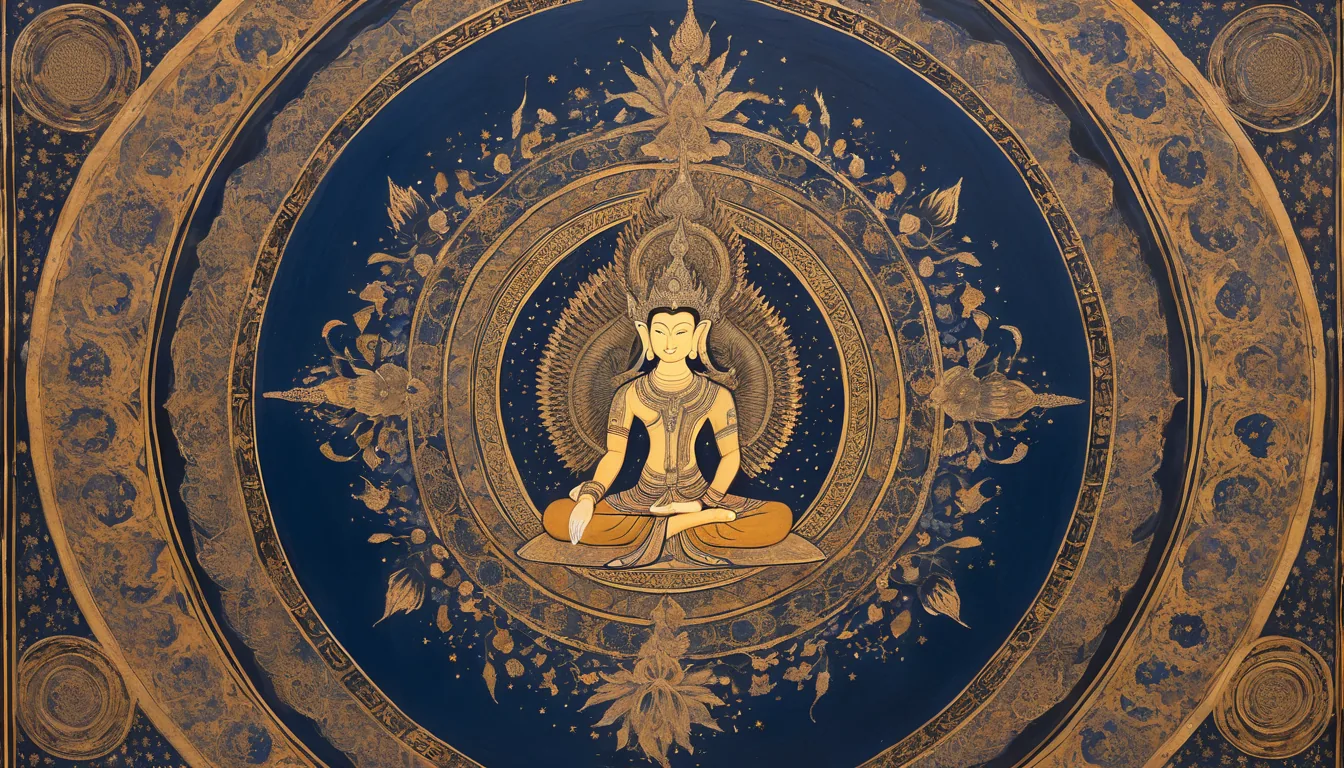
Jatukam Ramathep (Thai: จตุคามรามเทพ, also spelled Jatukham Rammathep) is the name given to a pair of guardian figures associated with Wat Phra Mahathat Woramahawihan in Nakhon Si Thammarat, southern Thailand, and to the large round amulets that carry their image [1], [7]. The first amulets were issued in 1987 in connection with the building of a new city pillar for Nakhon Si Thammarat [9], [16]. Two decades later, in late 2006 and 2007, they became the object of a nationwide buying frenzy, followed by a price collapse [12], [4], [11].
Key facts
| Fact | Detail | Source |
|---|---|---|
| Thai name | จตุคามรามเทพ; the name is read in two parts, Jatukam and Ramathep | [1] |
| Home temple | Wat Phra Mahathat Woramahawihan, Nakhon Si Thammarat; inscribed on the World Heritage List in 2026 | [1], [17] |
| First amulet | 1987 (BE 2530), linked to funding the new city pillar; one review of Reynolds's research gives 1986 | [9], [5] |
| Figure most linked to it | Police Major General Khun Phantharak Rajadej, who died in July 2006 | [3], [9] |
| Peak of the craze | Late 2006 to mid-2007 | [12], [7] |
| Reported market size | 20 billion baht (2007, per a Reuters report cited by Wikipedia) | [4] |
| April 2007 crowd crush | A crowd of more than 10,000 in Nakhon Si Thammarat stampeded; AP reported one woman dead and dozens injured | [9] |
| The bust | By April 2008 the Wall Street Journal reported most pieces were "practically worthless" | [11] |
What does Jatukam Ramathep mean?
The name is usually explained from Pali. English and Thai Wikipedia both derive "Jatu" from catu, "four", and "kam" from gama, a village or territory, giving the sense of a lord of the four directions; Thai Wikipedia adds that "Ram" refers to Rama and "thep" means deity [2], [1]. Religious studies scholar Justin McDaniel gives a related reading, the Pali compound Catugamaramadeva, "Rama of the Four Towns" [7].
McDaniel also records a second theory. The figures may take their names from Khattugama and Ramadeva, deities linked with the four protector gods of Sri Lanka, since Nakhon Si Thammarat received relics from Sri Lanka in the twelfth century [7]. He stresses that there are several competing explanations and none is settled [7].
Thai Wikipedia and Suksai treat Jatukam Ramathep as two figures, Thao Khattukham (later renamed Thao Jatukam) and Thao Ramathep, rather than one [1], [20]. A 2022 study in the Journal of MCU Buddhist Review treats the figure as a legendary hero tied to the ancient polities of Suvarnabhumi and Srivijaya, with Nakhon Si Thammarat as the setting of both the legend and its worship [21].
Guardians of Wat Phra Mahathat in Nakhon Si Thammarat
Thai Wikipedia and Suksai describe Thao Khattukham and Thao Ramathep as guardians of the relic stupa of Wat Phra Mahathat, said to reside on the western and eastern doors of the stairway up to the stupa [1], [20]. It explains them as Brahmanic deities who, after Buddhism took hold in the region, were recast as devas guarding the relics [1]. McDaniel notes four carved Hindu deities on the temple's wooden doors as one possible source of the name [7].
A popular identification links the figure with King Chandrabhanu (Chanthrabhanu), a ruler of the Srivijaya era [1]. Thai Wikipedia points out a problem with this: a related inscription is about 400 years older than the king [1]. According to a review of Craig Reynolds's research, Khun Phantharak Rajadej himself suggested in the 1980s that the deities were sons of King Chandrabhanu [5].
The temple itself is ancient. UNESCO's 2026 inscription decision says it was founded in the 8th century on the site of a Hindu shrine of the 5th–8th centuries, centres on the Great Reliquary of the Buddha, and reflects a fusion of Brahmanism, Hinduism, and Mahayana and Theravada Buddhism [17]. The World Heritage Committee inscribed it at its 48th session in Busan in 2026, under criteria (ii) and (vi) [17].
Who was Khun Phantharak Rajadej?
Khun Phantharak Rajadej (ขุนพันธรักษ์ราชเดช, born Butr Phantharak) was a police officer from Nakhon Si Thammarat [3], [5]. He studied at the police cadet school from 1925 and graduated in 1929, and received his noble title in 1931 [3], [6]. The title means "he who pledged to protect royal power" [5].
His career was spent largely suppressing banditry in the south [3], [5]. Historian Craig Reynolds, in an ANU Press biography reviewed in the Journal of the Siam Society, describes the harsh methods used under his command and his training in saiyasat (magical knowledge) at the Khao Or cave monastery in Phatthalung [5], [6]. Reviewer Patrick Jory notes that Reynolds counts 62 criminals killed during his career [6], while McDaniel writes that he killed "over 65 'bandits'" [7].
He was promoted to Police Major General on 1 October 1961 and retired in 1964 [3]. Chaloemtiarana describes his final post as police chief of Nakhon Si Thammarat [5], and Thai Wikipedia gives his formal rank from 1960 to 1964 as Commander of Provincial Police Region 8, headquartered in the province, adding that he was elected an MP for Nakhon Si Thammarat in 1969 [3]. Thai Wikipedia gives his death as 5 July 2006 [3].
His birth year is disputed. Reynolds's sources give 1898, 1900 or 1903, while Thai Wikipedia gives 1904 [5], [3]. Reported ages at death therefore range from 102 to 104 [3], [9], [7].
The first Jatukam amulet (1987) and the city pillar
The Associated Press reported in 2007 that the original batch was made in 1987 in Nakhon Si Thammarat to fund a pillar marking the city's founding site, and sold for under 50 baht (about US$2 at the time) [9]. The Journal of the Siam Society review of Reynolds's research dates the amulet's creation to 1986 and says it first sold for about ten baht [5]. Thai Wikipedia gives the first-batch price as 49 baht [1].
The new city pillar (หลักเมือง) itself dates from 1987. According to MGR Online, construction of the shrine began in 1987, the pillar's eye-opening rite was held on 5 March 1987 (Suksai dates the eye-opening rite at Sanam Na Mueang, where the first amulets were handed out to donors, to 3 March 1987), and King Bhumibol Adulyadej anointed its finial on 3 August 1987 [16], [20]. The pillar is carved from takhian thong wood from the summit of Khao Luang, and its top shows a four-faced Brahma that local people regard as Jatukam Ramathep [16]. Four smaller guardian shrines around it were completed in 1999 [16].
Accounts of who made the first amulet differ:
- The AP and McDaniel describe Khun Phantharak Rajadej as its creator [9], [7].
- Thai Wikipedia says he initiated a blessing ceremony that led to the first batch, without saying he made it himself [3].
- English Wikipedia says the amulets were produced with Police Lieutenant General Sanphet Thammathikul as chairman [2].
- A Bangkok Post timeline says a policeman first created them in 1987, after believing the spirit of Jatukam Ramathep had helped him solve a murder case [8].
The review of Reynolds's research reports the origin story told in Nakhon Si Thammarat. During the amulet's consecration, a spirit medium said the "man with the mustache" should be consulted, and the sponsors went to see Khun Phantharak [5]. These are accounts of what people said, not documented events.
What does a Jatukam amulet look like?
According to Thai Wikipedia, the first batch was a sun-and-moon medallion with a Rahu emblem: eight Rahu figures surround a central two-faced, four-armed figure that the makers described as a form of Avalokiteshvara [1], [2]. The review of Reynolds's research describes the iconography as a blend of the Buddha and two figures from the Srivijaya era (8th to 12th centuries CE) [5].
Size is the most obvious feature. The pieces measure about three inches across, which made them hard to wear under a shirt alongside other amulets, so owners wore them singly and openly [5]. The AP described them as coin-shaped, about the size of a silver dollar, made of bronze, silver or clay, often set in gold frames and hung on heavy chains outside the shirt [9]. McDaniel saw thousands of people wearing large round clay pieces outside their shirts [7].
The 2007 Jatukam boom: how it grew
McDaniel dates the rise of the "fever" (Thai khai) from 2004 to a peak in the summer of 2007 [7]. Political scientist Duncan McCargo writes that the cult "seized Thailand" in late 2006 and the first half of 2007, with Thais buying tens of millions of the amulets [12]. A 2011 study by Natchatanop Suksai describes 2005–2008 as the period when the amulets became openly commercial goods [20].
Several events fed the surge. Thai Wikipedia links earlier interest to the 1995 total solar eclipse, which drew attention to Rahu imagery [1]. The AP reported that Khun Phantharak Rajadej's funeral in February 2007 drew tens of thousands of people and helped spark the nationwide craze [9].
Crowds and the April 2007 crush
On 9 April 2007 the Bangkok Post reported that more than 10,000 people had camped overnight by a school compound to buy Jatukam Ramathep amulets [8]. The temple producing them was fully booked for consecration rites until the end of the year, and nearby hotels were full every weekend [8]. The director of the provincial Buddhism office, Sonthaya Senniam, said the craze had made Nakhon Si Thammarat an economic boom town [8].
The AP later reported that in April 2007 a Nakhon Si Thammarat crowd of more than 10,000, which had camped overnight outside a school, stampeded [9]. One woman died and dozens were injured [9]. Another AP report put it as "at least one death" when a crowd stampeded for a limited edition [10]. McDaniel's later journal article says two people were trampled to death as crowds rushed to the monastery [7]. The reports do not agree on the number of deaths.
The craze was also linked to crime. The AP reported robberies connected to the amulets [9], and McDaniel noted reports of people murdered over rare pieces [7].
Prices as reported in 2007
All figures below are prices reported in the press at the time, not valuations:
| Item | Reported price | Year | Source |
|---|---|---|---|
| First batch, at issue | under 50 baht (about US$2) | 1987 | [9] |
| First batch, at issue (alternative figure) | about 10 baht | 1986–87 | [5] |
| First edition, mid-2000s | over 100,000 baht | mid-2000s | [5] |
| Some pieces, August 2007 | over 100,000 baht (US$3,200) | 2007 | [9] |
| Rare pieces, August 2007 | over US$30,000 | 2007 | [9] |
| Rare pieces, August 2007 (alternative AP version) | over 1,000,000 baht | 2007 | [10] |
| Some editions, peak | over 3.8 million baht each | 2005–2008 | [20] |
| Top sales at the peak | up to US$75,000 | 2007 | [11] |
The AP said prices depended on materials, how pieces were consecrated (some were flown on a jetliner to be blessed by monks) and rarity [9]. Pieces were also sold abroad on eBay and through mail-order catalogues [9].
Market size and the local economy
Estimates of the overall market varied widely:
- English Wikipedia, citing Reuters (11 July 2007), puts the 2007 market at 20 billion baht, with as many as 150 series planned for that year [4].
- Thai Wikipedia cites a Fiscal Policy Office estimate of 22 billion baht in circulation, equal to 0.1–0.2% of GDP, and says the Revenue Department considered taxing the trade [1].
- The Wall Street Journal described it as part of a "billion-dollar-plus industry" [11].
- The Bangkok Post reported that the amulets were said to bring 100 million baht a week into Nakhon Si Thammarat [8].
Kasikorn Research Center reported on 27 April 2007 that Nakhon Si Thammarat received 1.367 million visitors in 2006, up 11%, with 3.353 billion baht in tourism income [18]. It forecast about 1.8 million visitors and about 5 billion baht in visitor spending for 2007, with souvenirs at about 1.3 billion baht [18].
Who issued them: editions, ceremonies and the press
Production spread far beyond the first batch. Thai Wikipedia counts nearly 1,000 editions, with consecration rites held at temples, markets, restaurants and hotels [1], and Suksai writes that more than 1,000 editions were produced in less than ten years [20]. In June 2007 former prime minister Chuan Leekpai presided over the first pressing of an edition made by the Thai Provincial Newspapers Association at Wat Phra Mahathat; MGR Online reported that pre-orders were almost sold out [13].
Temples outside the south joined in. In July 2007 a Nakhon Pathom temple consecrated its own edition to fund a new ordination hall, with the Deputy Interior Minister presiding, and the reporter noted that many temples in the province had produced Jatukam pieces [14].
The press played a large part. A 2007 Chulalongkorn University thesis analysed 724 issues of four Thai dailies from January to June 2007 [19]. It found that amulet coverage raised advertising sales and that editors acknowledged the press had helped fuel the "Jatukam fever" [19]. Several leading monks, meanwhile, criticised the trend as contrary to Buddhist values and driven by financial greed [8].
How the Jatukam market collapsed
The decline began within months. English Wikipedia, citing a Nation report of 26 August 2007, says that by late 2007 the bubble appeared to have burst, with plenty of amulets available at low prices [4]. The Chulalongkorn thesis notes that newspapers themselves covered the trend's decline once amulet advertising reached saturation [19].
On 7 April 2008 the Wall Street Journal reported that the market had collapsed in the preceding weeks [11]. It gave two causes: a glut of supply, and growing suspicion that many pieces had not been properly consecrated by monks [11]. Most of the clay pieces, it said, were now "practically worthless" [11].
The province tried to revive interest. In August 2009 Nakhon Si Thammarat held a "777 Days Return to Nakhon" ceremony attended by more than 10,000 people, with an exhibition of over 50 Jatukam editions [15]. Its 23,331 commemorative items were given away free, not sold, and the governor said he believed the craze would return [15].
Why did the Jatukam boom happen? What researchers say
Scholars give several explanations, all reported as interpretations:
- Anxiety. McCargo reads the craze as a symptom of national anxiety over the economy, politics and the royal succession [12]. The AP quoted archaeologist Srisak Vallibhotama linking it to people losing faith in religious, social and judicial institutions [9].
- The policeman's reputation. McDaniel argues that the amulet's appeal came partly from its association with a famous southern police general [7].
- Marketing. Suksai's study shows how advertising and public relations at every stage of production built the amulets' meaning and price [20].
- The media. The Chulalongkorn thesis found that commercial incentives drove newspaper coverage, and that most interviewees saw the craze as commercial Buddhism and a passing fashion [19].
- Speculation. McDaniel lists economic speculation and peer pressure among the causes [7].
Jatukam Ramathep today
The figure is still part of Nakhon Si Thammarat's civic landscape. The city pillar shrine, with its Jatukam-identified finial, remains a place of visits and offerings [16]. In MGR Online's 2026 account, the craze is described as having peaked around 2006–2007 [16].
The temple linked to the figures now has World Heritage status, inscribed in 2026 for its architecture and its role as the spiritual centre of the province [17]. ThaiAmuletExchange's price index does not currently track a Jatukam series.