
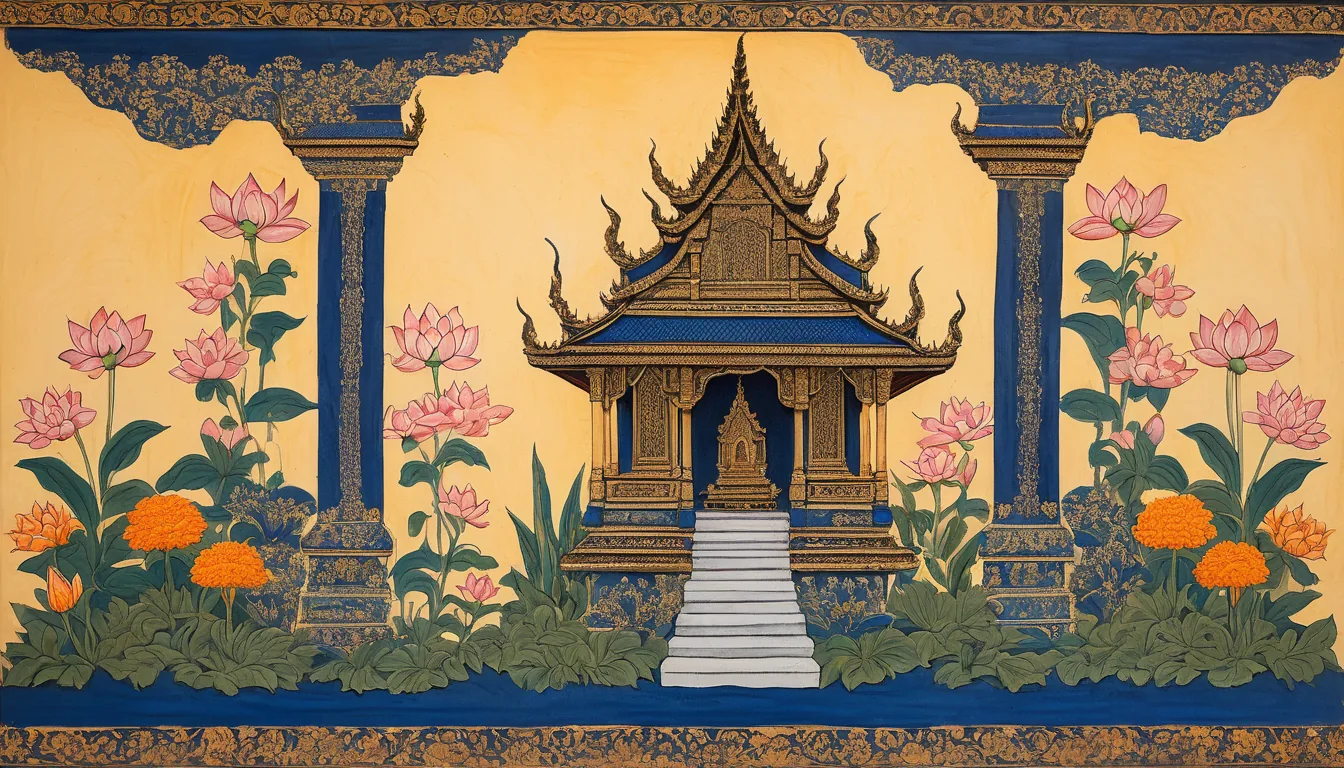
A Thai spirit house is a small shrine, usually a miniature house or temple raised on a pillar, set up in the grounds of a home or building as the dwelling of the guardian spirit of that land [1], [2]. In Thai it is called san phra phum (ศาลพระภูมิ), "the shrine of the Phra Phum". It is often paired with a lower san chao thi (ศาลเจ้าที่), also called san ta-yai (ศาลตายาย), for the spirits of the land itself [2], [8]. Owners present flowers, food and drink at the shrine, and its installation is traditionally timed and oriented by a Brahmin officiant [2], [3].
Key facts
| Fact | Detail | Source |
|---|---|---|
| Thai names | ศาลพระภูมิ (san phra phum); ศาลเจ้าที่ (san chao thi) or ศาลตายาย (san ta-yai) | [2] |
| Regional spread | Shrines of this kind are recorded in eight Southeast Asian countries, including Thailand, Laos, Cambodia and Myanmar | [1] |
| Form | Phra Phum shrine usually on one pillar; ta-yai shrine usually on four or six, modelled on a Thai wooden house | [2] |
| Officiant | A Brahmin is traditionally called in to fix the auspicious time and direction | [2] |
| Ritual focus | The jawet (เจว็ด), a tall sema-shaped tablet standing for the guardian | [3], [10] |
| Typical offerings | Garlands, flowers and food; rice, bananas, coconuts, desserts and red soda | [1], [2] |
| Belief roots | Indigenous spirit belief blended with Brahmanism and Buddhism | [3], [6], [7] |
What is a Thai spirit house?
In English, "spirit house" covers two kinds of shrine found in Thai house compounds: the san phra phum and the san chao thi. Both provide for non-physical beings attached to a place [8]. Across the region, the spirit house is described as a shrine to the protective spirit of a site. It is usually a small roofed structure on a pillar or dais, ranging from a small platform to a building large enough to enter [1].
Thai Wikipedia defines the Phra Phum as thepharak (เทพารักษ์), guardian deities believed to watch over buildings, homes and offices [2]. The shrine gives them a dwelling of their own. A Pattani field study explains the logic in local terms: the Phra Phum is held to be unable to live inside a human house, so a small house is built for it [3].
Neighbouring cultures have related shrines. In Khmer the equivalent is rean preah phum (រានព្រះភូមិ), and in Burmese nat sin. Chinese earth-god shrines, called 土地神屋 or "Tudigong houses", are listed as a parallel tradition [1].
How common are spirit houses?
Most houses and businesses in mainland Southeast Asia have one, usually in a corner of the property [1]. A Thai Buddhist ethics study describes the custom as one shrine per household [6]. Thai Wikipedia notes they are less common in northern Thailand, where ancestral spirits (phi pu ya) are already believed to watch over the household [2].
San phra phum vs san chao thi: what is the difference?
Thai sources treat the two shrines as different in who they house, how they are built and where they stand.
| Feature | San phra phum (ศาลพระภูมิ) | San chao thi / san ta-yai (ศาลเจ้าที่ / ศาลตายาย) |
|---|---|---|
| Believed occupant | Guardian deity (thepharak) [2] | Spirits of the land; linked to ancestors [2], [4], [12] |
| Pillars | Usually one, often concrete [2] | Usually four or six [2] |
| Height | The higher of the two [2] | Set lower than the Phra Phum shrine [2] |
| Typical form | Small house, temple or palace (prasat) [2], [7] | Thai wooden house [2] |
| Incense in one press guide | 9 sticks [4] | 5 sticks and 2 candles [4] |
The monk Luang Por Ruesi of Wat Tha Sung, in a teaching republished by Naewna in 2021, distinguishes two senses of chao thi: a former human or animal owner of the land, or a sky deity (akat thewada) of the Catumaharajika heaven [5]. He explains that a sky deity uses a four- or six-pillar shrine while an earth deity (phum thewada) uses a single pillar, and likens the sky deity to a subdistrict or village headman (kamnan or phu yai ban) who oversees several dozen Phra Phum sites [5]. A 2025 Nation Thailand explainer describes, as belief, the Phra Phum shrine as watching over homes and businesses and the ta-yai shrine as honouring ancestors [12].
Is a Brahma shrine a spirit house?
No. A Brahma shrine (san phra phrom) houses Phra Phrom, the Thai form of the Hindu god Brahma, and is a separate type [9], [12]. Bangkok's Erawan Shrine is the best-known example. It was built for the government-owned Erawan Hotel after construction setbacks, on an astrologer's advice. The Fine Arts Department designed the statue, which was enshrined on 9 November 1956 [9]. Many worshippers nevertheless approach it as a guardian spirit, in line with animist practice [9].
Where does the spirit house belief come from?
Scholars trace the shrine to several layers of belief rather than one origin.
- Indigenous spirit religion. Before Buddhism and Brahmanism reached them, local communities followed a religion of spirits (satsana phi). Its spirits included the phi ta-yai, the house spirit (phi ruean) and the sky spirit (phi fa) [6].
- Brahmanism. Brahmanical customs spread among Thais, especially in the central and southern regions [6]. The Pattani study describes Phra Phum belief as inherited from Brahmanism and blended with Buddhism [3].
- Sacred space and ancestors. A 2026 review argues that the sacred site began as the burial place of a tribal leader or ancestor revered as a protector. It later became the village guardian shrine [7].
- Buddhist framing. The same review says Buddhism recast the guardian as a deity living in a palace, linking the Phra Phum to the Four Heavenly Kings and earth deities (bhummadeva) of the Mahasamaya Sutta and to the protective deities receiving offerings (balikamma) in the Ratana Sutta [7].
Reporters make the same point in plainer terms: belief in spirits is tied to animism rather than Buddhism, although people mix the two [13]. The Pattani authors note that Phra Phum worship sits uneasily with Buddhist doctrine. They describe it as a deity cult carried over from Brahmanism [3].
How is a spirit house installed? The Brahmin ceremony
Thai Wikipedia states that a Brahmin is called to determine the auspicious time (ฤกษ์ยาม) and direction, and to prepare the ceremony and offerings [2]. The Pattani study, which interviewed 30 householders and 3 local ritual experts, found that details vary from one officiant to another. The principle does not vary: the time, place, day, direction, offerings and invocations must all be exact [3].
Choosing the day
Local custom in Khok Pho district, Pattani, matches the day to the kind of shrine [3]:
- Wednesday or Thursday for a household shrine.
- Thursday or Friday for shrines at fields, orchards and temples.
- Sunday, Tuesday or Thursday for shrines at camps, moats, gates and watchtowers.
- Saturday for shrines at doorways and stairs.
- Monday or Wednesday for the shrine of a bridal house.
The same source lists forbidden weekdays month by month. For example, Tuesday is avoided in January, February, June and October [3].
Choosing the spot
The placement rules recorded in the Pattani study and in Thai Wikipedia include [2], [3]:
- Along the fence, often at the front, but not facing the house door.
- On ground higher than the house floor that does not flood and is free of refuse.
- Outside the shadow of the house.
- With no watercourse or drain beneath it, and nothing blocking it.
- On a patch of about 2 square metres, or a square plot measuring 4 wa 4 sok on each side so people can walk around the shrine.
- With the shrine slightly above the owner's eye level.
Older practice put the shrine at eye level on a wooden post. Later fashion raised it slightly above head height [3]. On direction, Thai Wikipedia gives north or east, following Brahmin teaching [2]. The Pattani experts favour east, north-east, south-east and north, and avoid west and south [3].
What happens during the ceremony?
The Pattani study lists what a householder prepares: the shrine, the jawet, and attendant figurines of men, women, dancers, elephants and horses [3]. Ritual equipment includes vases, candlesticks, an incense pot, cloth for the jawet and the shrine, three-coloured silk, and silver and gold parasols (chat). It also includes sacred cotton thread (sai sin), gold leaf, seven-coloured flowers and garlands, a bowl of lustral water, and the officiant's teacher-offering tray (phan khru) [3].
Items laid in the pillar hole include silver and gold coins, leaves with auspicious-sounding names such as bai ngoen and bai mayom, marigolds and chaiyaphruek wood. Householders use whatever they can obtain; a full set is not required [3].
A press example shows the sequence in practice. In November 2025, The Standard reported a ceremony at a political party's new head office in Bangkok, the Palang Pracharath Party, to set up both a Phra Phum and a ta-yai shrine [11]. The steps were these:
- An auspicious wooden stake was driven in.
- Garlands were offered, and incense and candles were lit.
- Auspicious objects were hammered into the shrine's base.
- Gold and silver sheets were laid, and gemstones were scattered.
The offerings were 3 savoury dishes, 7 kinds of fruit and 9 kinds of sweets [11].
Spirit house offerings: what do people give?
Installation offerings are elaborate. In Khok Pho they include savoury and sweet dishes, puffed rice, liquor, tea, scented powder and perfumed oil. A bai si with an egg on top, a betel tray, cigarettes, white cloth, flowers, incense, candles and fruit complete the set [3]. The teacher offering adds red and white khanom tom, yellow and white sticky rice, bananas, sugar cane, beans and sesame. The chao thi receives liquor, chicken and savoury and sweet food [3].
Some fruits are kept off the tray because their Thai names sound inauspicious. These include sapodilla (ละมุด), star fruit (มะเฟือง), mafai (มะไฟ) and nipa palm fruit (ลูกจาก) [3].
Everyday offerings are simpler. Thai Wikipedia lists garlands, flowers and food, usually presented before a household ceremony or on an important day [2]. Common items are rice, bananas, coconuts and desserts [1]. A 2024 Thairath guide lists the following [4]:
- Food: pork, duck, chicken or seafood, and golden Thai desserts such as thong yip and thong yot.
- Drinks: tea, water, soda or coconut water.
- Other items: fruit, candles, garlands and fresh flowers.
- Incense: 9 sticks for the Phra Phum, and 5 sticks with 2 candles for the ta-yai.
The same guide suggests a late-morning window and offerings every three or six months, or yearly at New Year or Songkran [4]. Pattani informants stress that offerings need not be lavish: households can give what they normally eat [3].
Why do Thai spirit houses have red Fanta?
Red, strawberry-flavoured Fanta is widely described as the most common drink left at Thai spirit houses, a custom that has existed for decades [1]. English Wikipedia, citing a 2017 report by Patrick Winn, notes several explanations offered for the practice [1]:
- Red and sacrifice. Most explanations point to the colour red as reminiscent of earlier animal sacrifice.
- Incense dye. Another explanation links the custom to standing red incense sticks in a glass of water, which tints the water red.
- Sweetness. A third explanation holds that sweet-natured spirits are thought to favour sweet drinks.
Thai spirit house design: the jawet, figurines and colours
The jawet
The centre of the shrine is the jawet (เจว็ด), ordinarily a tall wooden tablet shaped like a boundary stone (sema), with a narrow waist and a curved, pointed top, standing for the guardian spirit of the place [10]. Art historian Praphat Chuvichean writes that early jawet were plain boards, reflecting the worship of spirits without form, and later makers painted or carved a deity onto them, typically holding a sword (phra khan) [10]. He dates six carved wooden jawet at the Pun Tao Kong shrine in Tha Chalom, Samut Sakhon, to the mid-16th to mid-18th centuries (Ayutthaya period), noting that these early examples are tall rectangular pointed boards without the narrow waist of later jawet, and that one depicts Phra Kan Chai Si riding a bird [10].
Figurines and fittings
Figures placed on or around the shrine include servants, soldiers, elephants, horses and consorts, along with vases and incense pots [2]. Dancer figurines are also part of the standard set [3].
Architecture
The traditional shrine is a Thai house with gable finials (chofa), serrated bargeboards (bai raka) and swan-tail ends (hang hong) [3]. Modern makers cast whole shrines in concrete and stucco, larger than before. They model them on ordination halls, preaching halls, mondop pavilions, prang towers and palaces [3]. A 2026 review reads the palace form as an idealised image of Mount Meru and the heavens [7].
Colours
By old preference a spirit house is gold. Some owners use their birthday colour instead [3]:
| Day of birth | Shrine colour |
|---|---|
| Sunday | Pink or deep red |
| Monday | Yellow |
| Tuesday | Purple-red |
| Wednesday | Green |
| Thursday | Gold |
| Friday | Light blue |
| Saturday | Purple |
Where you will see spirit houses
Spirit houses stand outside homes, shops and offices across Thailand [2], [12]. Government offices and large stores often install big, costly ones [3]. Some tall buildings without spare ground put them on the roof [3], although one Thai authority quoted in the Pattani study holds that a rooftop shrine should be a Brahma or deity shrine rather than a Phra Phum [3].
They also appear at fields, orchards and temples, as the day rules above show [3]. Outside Thailand, similar shrines are found in Laos and Cambodia [2], and the wider tradition reaches across mainland and maritime Southeast Asia [1].
What happens to old spirit houses?
Because no one likes to destroy a sacred object, removed shrines are often left under bodhi trees in temple grounds. The Pattani study notes that this leaves temples with the burden [3]. One approach used by local ritual experts is to break the old shrine during the new installation and spread its fragments on the new site [3].
Cost is a factor in decline. Pattani informants said fewer people now set up shrines, because officiants' fees, shrines and offerings are expensive [3].