
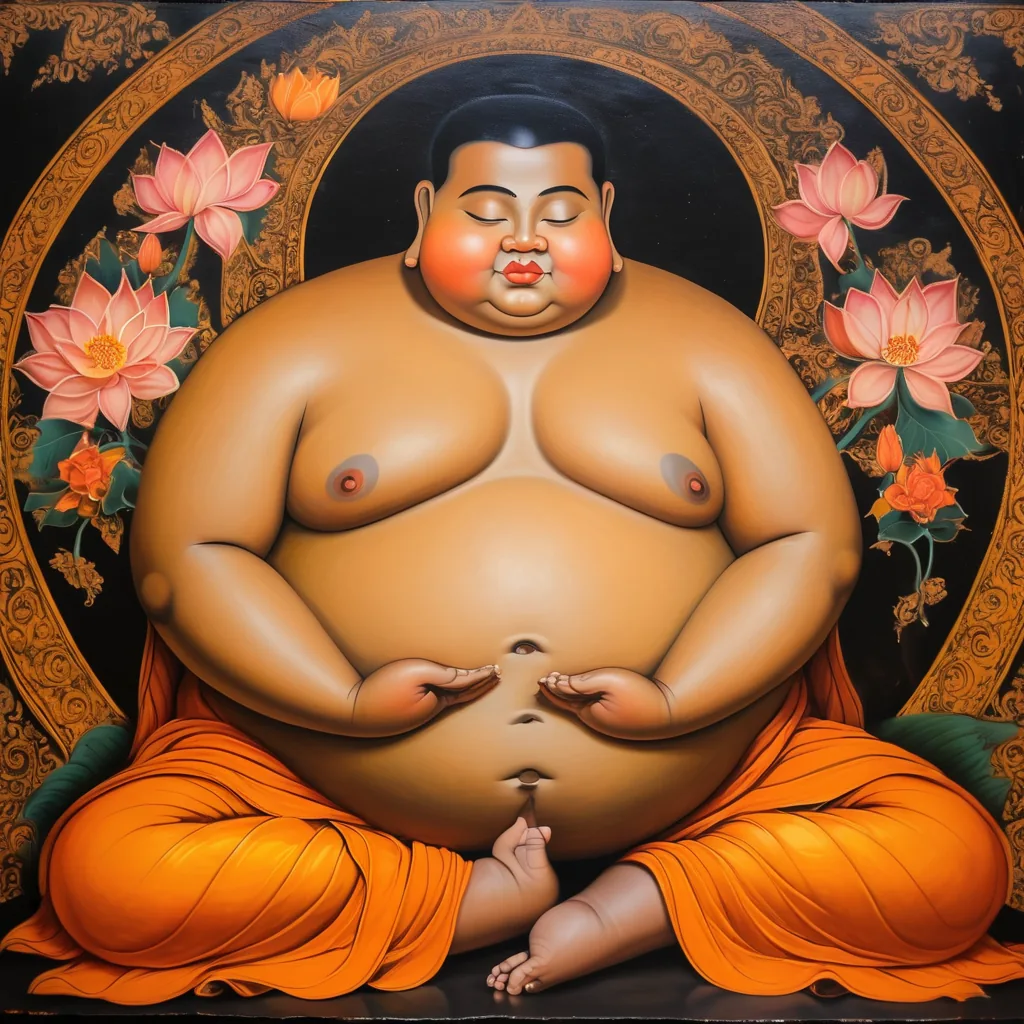
Phra Sangkachai is the name Thai Buddhists use for Mahākaccāna, an arahant disciple of the Buddha and one of the eighty great disciples (พระอสีติมหาสาวก) [3]. In English the Thai name is also romanised as "Phra Sangkajai" [8]. Thairath counts his image among those most widely venerated by Thai and Chinese devotees [9]. In Thai art he is shown as a short, round-bellied monk, unlike the handsome figure of the early texts [2], [6].
Key facts
| Fact | Detail | Source |
|---|---|---|
| Pali name | Mahākaccāna | [1] |
| Canonical title | Foremost of those who explain in detail the meaning of a brief statement (AN 1.197) | [1] |
| Birthplace | Ujjenī, capital of Avanti; son of the royal chaplain | [2] |
| Birth name | Kañcana ("golden"), from his golden complexion | [2], [6] |
| Example exposition | Madhupiṇḍika Sutta, the "Honeyball" discourse (MN 18) | [2] |
| Thai vs Chinese image | Thai image: curled hair and a Theravāda robe. Budai: bald, with a robe open over the belly | [3], [4], [7] |
Name and identity
One explanation for the Thai form is reported in an article in the Mahachula Academic Journal. In the First Reign of the Rattanakosin period, foundations were being dug for an ordination hall at a temple in the Thonburi area. A sculpture of Mahākaccāna was found there together with conch shells (หอยสังข์). The temple later became known as Wat Sang Krachai (วัดสังข์กระจาย), and the author proposes that "Sangkachai" grew out of the temple's name combined with "Kaccāyana" [4]. He calls this a supposition (สันนิษฐาน), so it should not be taken as documented history [4].
Scriptural sources
In the Aṅguttara Nikāya the Buddha names Mahākaccāna as the foremost of the monks "who explain in detail the meaning of a brief statement" (AN 1.197, segment an1.197:1.1 on SuttaCentral) [1].
Bhikkhu Bodhi's study for the Buddhist Publication Society brings the Pali record together [2]:
- He was born in Ujjenī, the capital of Avanti. He belonged to the Kaccāyana clan (shortened to Kaccāna), and his father was the chaplain (purohita) of Ujjenī; Kaccāna later succeeded him as court chaplain.
- His golden complexion gave him his birth name, Kañcana ("golden").
- King Caṇḍappajjota sent him to invite the Buddha to Ujjenī. He went with seven companions, heard the teaching, attained arahantship and was ordained.
Thai Wikipedia adds that he spread the teaching in Avanti [3].
Several discourses show the skill behind his title. In each, he expands a short saying of the Buddha. Examples include the Madhupiṇḍika Sutta (MN 18), the Mahākaccāna Bhaddekaratta Sutta (MN 133) and the Uddesavibhaṅga Sutta (MN 138) [2]. The colophons of two later exegetical works, the Nettippakaraṇa and the Peṭakopadesa, credit them to him [2], although Bodhi notes that Western scholars have been inclined to dismiss the attribution as fanciful [2]. A Pali grammar, the Kaccāyana-vyākaraṇa, is also traditionally linked to his name [2]. In the Mahāyāna tradition, chapter 6 of the Lotus Sūtra records a prophecy that he will become a Buddha [3].
The legend of the rotund form
The classical sources describe him as good-looking, with a golden hue [2], [4]. The Dhammapada Commentary tells the story of Soreyya, a treasurer's son. When Soreyya saw the elder, he wished for a wife who looked like him, and he was at once turned into a woman. Later he asked the elder's forgiveness, became a man again, ordained under him and attained arahantship [2], [4].
Bodhi's survey of the Pali material contains no account of the elder changing into a stout figure [2]. That story comes from Thai tellings, and the Mahachula Academic Journal article describes it as an added tale (เรื่องแทรก) [4]. The tellings give different reasons:
- His beauty caused turmoil among women, so he remade his body fat and pot-bellied to quiet the passions it stirred [4].
- Men wished for wives as beautiful as he was. Troubled by this, he resolved to become plump, with a protruding belly [5].
- Devotees praised his face as resembling the Buddha's. He thought this improper and made himself rotund [5].
- To avoid causing conflict, he used the power of his merit to change his body into a short, squat form [6].
Iconography
Daily News describes a short, squat body with a pot belly, a large head and short legs [6]. Thairath describes a plump, full figure with a protruding belly [5]. According to Thai Wikipedia, Thai images give him snail-shell curls like those of a Buddha image, and he wears Theravāda monastic robes [3]. The Mahachula article adds that the robe crosses the body diagonally, with the outer robe (สังฆาฏิ) laid over the shoulder, as on Theravāda Buddha images [4].
In Thai temples and amulets
Daily News connects Mahākaccāna with the Phra Pidta (พระปิดตา), a figure also called Phra Phakhawampati (พระภควัมปติ). The paper calls it a representation of the elder [6]. Thairath likewise lists a Phra Pidta Sangkachai among the well-known Sangkachai issues [5].
On 12 May 2025, Thairath named five issues as popular [5]:
| Issue | Temple | Details reported |
|---|---|---|
| Phra Pidta Sangkachai, Luang Pu Thim | Wat Lahan Rai, Rayong | 1,600 pieces; nine-metal alloy (เนื้อนวโลหะ); sequential code stamped on the base |
| Luang Pho Kuay | Wat Khositaram, Chai Nat | Issued at Wat Nong I-Duk in 2515 BE (1972), at a boundary-marker (sīmā) ceremony for an ordination hall |
| Luang Pu To | Wat Pradu Chimphli, Bangkok | Two issues: a committee set in 2520 BE (1977) and the "Pawaret" issue in 2522 BE (1979) |
| Luang Pho Ngoen | Wat Bang Khlan, Phichit | Issued at Wat Khwang; four moulds: Phim Niyom, Phim Khi Ta, large (big head, bulging belly) and small |
| Sao Ha issue | Wat Suthat, Bangkok | 2485 BE (1942); 500 pieces |
The same article reports the popular associations. Thairath associates Phra Sangkachai with good fortune (โชคลาภ) and, for two individual issues (Luang Pho Kuay and Luang Pu To's Pawaret), with being well liked (เมตตามหานิยม) [5]. These are reported beliefs; this encyclopedia makes no claim about what any object does.
Hair and robe show whether a rotund figure is the Thai elder or Budai (below).
Distinguishing Phra Sangkachai from Budai
Thai Wikipedia notes that Thai Buddhists often confuse images of Mahākaccāna with Budai (Thai: พระปู้ไต้). Budai is a Chinese monk, called Hotei in Japan, who is often identified with the future Buddha Maitreya [8]; Thai Wikipedia attributes this view to Zen, Taoist and Shinto traditions [3]. English Wikipedia also notes that Budai is sometimes confused in Thailand with "Phra Sangkajai" [8].
Budai's name means "cloth sack", and he is associated with the Later Liang period [8]. A Princeton University Art Museum rubbing shows him bald and portly, with his robe open over his belly and a staff over his shoulder. The museum's notes say he later came to be known as the "Laughing Buddha" [7]. The Mahachula article identifies the Chinese fat figure as Maitreya (หมีเล่อฝอ), a figure distinct from Sangkachai (the author also argues that a hermeneutic reading can treat the two as one). It also states that images of this figure first appeared in the Song dynasty [4].
How to tell them apart:
- Hair: Phra Sangkachai has Buddha-like curls. Budai is bald [3], [7].
- Robe: Phra Sangkachai wears a diagonal Theravāda robe with the outer robe over the shoulder. Budai's robe is open at the front over the belly [3], [4], [7].
- Attributes: Budai carries a cloth sack, and in some images a staff [7], [8].
Related terms
- Mahākaccāna / Kaccāyana: the Pali disciple behind the Thai name [1], [2].
- Etadagga (เอตทัคคะ): the "foremost" designation the Buddha gave to leading disciples [1], [3].
- Soreyya: the treasurer's son in the Dhammapada Commentary story [2].
- Phra Pidta / Phra Phakhawampati (พระปิดตา / พระภควัมปติ): the figure linked to Mahākaccāna in Thai amulet tradition [6].
- Budai / Hotei / Pu Tai: the Chinese "cloth-sack" monk often confused with Phra Sangkachai [3], [7], [8].
- Maitreya (พระศรีอารยเมตไตรย): the future Buddha, whom Budai is held to represent [3], [4].
Where to see pieces like this — Our sister shop, Shogun X Amulets, has published an article on Phra Sangkachai: https://shogunxamulets.com/the-wealth-buddha-of-thailand-who-phra-sangkachai-really-is-and-why-everyone-loves-him/. Disclosure: Shogun X Amulets and ThaiAmuletExchange.com are run by the same group.