
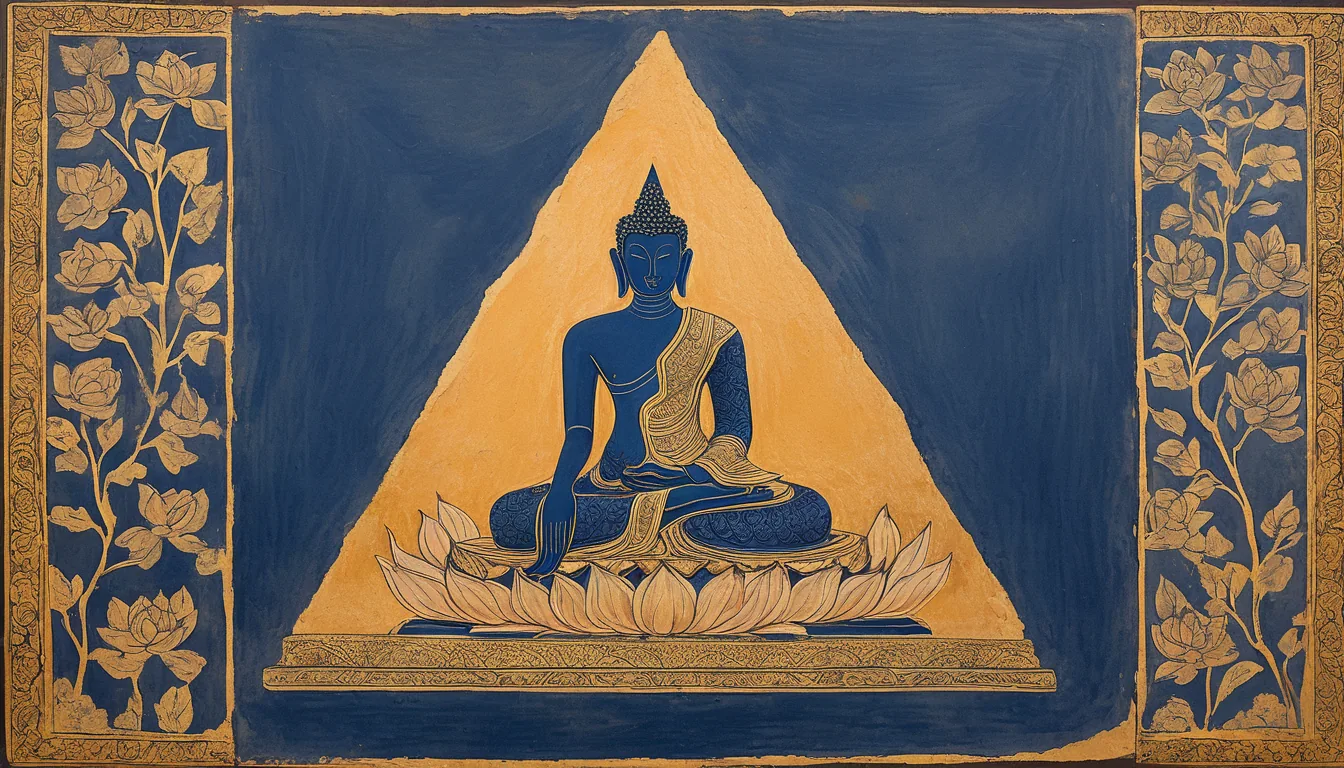
Phra Nang Phaya (พระนางพญา) is a triangular baked-clay Buddhist votive tablet excavated from Wat Nang Phaya in Mueang Phitsanulok District, Phitsanulok Province, and recognized since 1952 as the Ayutthaya-period representative in Thailand's five-piece Benjapakee (เบญจภาคี) pantheon [1][2][3]. Attributed to Queen Wisutthikasat (พระวิสุทธิกษัตรีย์) — consort of King Maha Thammarachathirat and mother of King Naresuan the Great — around BE 2090–2100 (1547–1557 CE), the tablet depicts the Buddha seated in the subduing-Mara posture (ปางมารวิชัย, Maravijaya) inside an isosceles triangle without a surrounding arch [1][2][8]. In Thai collecting literature, it carries the title "Queen of Amulets" (ราชินีแห่งพระเครื่อง, Rachini Haeng Phra Khrueang) both for its royal maternal attribution and for its sculpted anatomy, which pairs a prominent raised chest (อกตั้งนูน, ok tang nun) with slender, tapering arms [1][3].
First unearthed in official records in BE 2444 (1901 CE) when Wat Nang Phaya prepared pavilions to receive King Chulalongkorn (Rama V), Phra Nang Phaya Phitsanulok tablets are studied across seven classic moulds (พิมพ์, phim) divided into large and small formats, alongside four principal kiln-fired clay tones [1][8][9][10]. Because its coarse, sand-rich terracotta body (เนื้อดินผสมว่านและเกสรดอกไม้, clay mixed with herbs, pollen, and quartz grit) differs markedly from the fine alluvial clays of Lamphun, Suphan Buri, and Kamphaeng Phet, authentication relies on examining both mould geometry and the exposed mineral grains (เม็ดแร่, met rae) on its surface and reverse [1][9][12].
Royal Ayutthaya origins and Wat Nang Phaya
Wat Nang Phaya stands on the east bank of the Nan River in Tambon Nai Mueang, Mueang Phitsanulok District, immediately adjacent to Wat Ratchaburana and southeast of Wat Phra Si Rattana Mahathat (the temple housing Phra Phuttha Chinnarat) [2][5]. Historically, when Phitsanulok served as the northern viceregal capital (เมืองลูกหลวง, mueang luk luang) of the Ayutthaya Kingdom, Wat Nang Phaya and Wat Ratchaburana formed sister royal monasteries within a shared precinct before the construction of the modern Phitsanulok–Lom Sak highway separated their grounds [2][5][10].
Historical chronicles and temple tradition credit the founding of Wat Nang Phaya and the deposit of its votive tablets to Queen Wisutthikasat — daughter of King Maha Chakkraphat and Queen Suriyothai, consort of Somdet Phra Maha Thammarachathirat, and mother of Phra Suphankanlaya, King Naresuan the Great, and King Ekathotsarot — during the royal restoration works of c. BE 2090–2100 (1547–1557 CE), with some specialist catalogues narrowing the consecration window to c. BE 2095–2100 [1][2][8][10]. Following the ancient Buddhist dhammakhandha (พระธรรมขันธ์) convention, 84,000 clay tablets were pressed and interred inside the temple's masonry to perpetuate the dispensation [1].
On 27 September BE 2479 (1936 CE), Thailand's Fine Arts Department registered Wat Nang Phaya as an ancient national monument (โบราณสถาน), covering the old Sukhothai-style wihan (later converted into the ubosot) and two twelve-indented-corner stupas (เจดีย์ย่อมุมไม้สิบสอง, chedi yo mum mai sip song) standing behind the hall [2][10]. Architectural surveys recorded by Kom Chad Luek give the dimensions of the larger stupa as 9.10 × 9.10 metres at the base by 11.60 metres high, and the smaller stupa as 3.70 × 3.70 metres at the base by 7.95 metres high [10]. Originally, Wat Nang Phaya had no ordination hall (ubosot) of its own, only the six-bay wihan noted by Prince Narisaranuvattiwong on 13 May RS 120 (1901 CE) together with an antique Vietnamese cast-iron bell measuring two sok in height [2][10]. In BE 2515 (1972 CE), abbot Phra Khru Bowon Chinnarat (Muan) rebuilt the decaying wihan into a 10.50 × 20 metre ubosot, for which King Bhumibol Adulyadej (Rama IX) granted the royal auspicious timing for the boundary-stone consecration (ผูกพัทธสีมา) on 19 January BE 2521 (1978 CE) [10]. Today the ordination hall houses the principal Buddha image Phra Somdet Nang Phaya Ruean Kaeo and opens daily from 05:00 to 19:00 under acting abbot Phra Khru Kasem Wapiphisai [2][11].
Role in Triyampawai's Benjapakee classification
For half a century after the 1901 excavation, Phra Nang Phaya circulated among royal courtiers, military officers, and senior collectors without being locked into a five-piece canon [5][14]. In BE 2495 (1952 CE), military officer and amulet scholar Colonel Prayoon Ploywimon (later Pajon Kittiprawat, writing under the pen name Triyampawai, ตรียัมปวาย) first formulated a three-piece set called the Traiphakhi (ไตรภาคี, "Triad") [3][4][5][6]. In that initial triad, Triyampawai placed Phra Somdej Wat Rakang at the centre flanked by Phra Nang Phaya of Wat Nang Phaya (Phitsanulok) and Phra Rod of Wat Mahawan (Lamphun) [4][5][6].
Shortly afterward, Triyampawai expanded the triad into the five-piece Benjapakee by adding Phra Kamphaeng Sum Kor of Kamphaeng Phet and Phra Phong Suphan of Suphan Buri, uniting masterpiece votive tablets from the Hariphunchai/Dvaravati, Sukhothai, U Thong/early Ayutthaya, middle Ayutthaya, and Rattanakosin periods [3][4][5][6]. On 20 June 2004 (BE 2547), Thailand Post commemorated the set with its Phra Khrueang Benchaphakhi postage stamp series (issue 2004/45–49, printed by Thai British Security Printing in runs of 1,500,000 per stamp at 9 baht face value), placing Phra Nang Phaya of Wat Nang Phaya on the first stamp of the five-design sheet [7].
Chronology of hoard excavations (kru) in Phitsanulok
Unlike amulets recovered in a single event, Phra Nang Phaya Phitsanulok tablets emerged through several documented waves of excavation at Wat Nang Phaya and neighbouring sites [1][10][15][17]:
- BE 2444 (1901 CE) — The King Rama V royal visit discovery: When workers dug postholes to erect a reception pavilion for King Chulalongkorn's visit to Phitsanulok on 16 October RS 120 (1901 CE, during the casting of the replica Phra Phuttha Chinnarat for Wat Benchamabophit in Bangkok) and cleared debris around the ruined wihan and stupas, they uncovered large quantities of triangular clay tablets [1][5][8][10]. The temple presented prime examples to King Chulalongkorn, who distributed tablets to members of the royal court and civil officials [1][8]. According to Post Today and Thairath, King Rama V also brought surplus tablets back to Bangkok and deposited groups inside stupas at Wat Sangkatchai, Wat Prasat Boonyawat, and (in one alms-bowl, หนึ่งบาตร) the chedi of Wat Intharawihan at Bang Khun Phrom [9][14]. When thieves broke into the Wat Intharawihan chedi around BE 2492 (1949 CE), collector Ari Phromprasit of Thewet and later Triyampawai acquired several of those alms-bowl tablets, which exhibited a dark, water-steeped reddish-brown skin known as phiu kriam (ผิวเกรียม) from rainwater seeping into the bowl [14].
- BE 2480 (1937 CE) — The Kru Rong Tho (Textile Mill) hoard at Wat Phothiyan: As documented by Thairath columnist Sika Ang, when the Royal Thai Army cleared ruined stupa mounds north of Wat Pho (now Wat Phothiyan) on the Nan River bank in Phitsanulok around BE 2480 to build a military textile mill (โรงทอผ้า), workers unearthed contemporaneous Ayutthaya triangular clay tablets known as Phra Nang Phaya Kru Rong Tho in two moulds: Phim Yai Mi Hu (large mould with ears) and Phim Lek Mai Mi Hu (small mould without ears) [17].
- BE 2485 (1942 CE) — Wartime air-raid trench find: During the Second World War, residents digging air-raid shelter trenches in the banana grove behind Wat Nang Phaya struck buried pockets of tablets that had dispersed from the old masonry [10].
- BE 2497 (1954 CE) — Abbot Thanom's kuti excavation: Additional tablets were uncovered in the soil directly in front of the monastic quarters (กุฏิ) of Abbot Thanom at Wat Nang Phaya [10].
- BE 2512 (1969 CE) — The water-immersed (kru nam) find: Around BE 2512, villagers digging roughly 4 to 5 kilometres from Wat Nang Phaya discovered another cache of Nang Phaya tablets resting in damp ground [1]. Prolonged groundwater contact washed away the fine clay slip on these pieces, leaving rough, exposed quartz grains and dark lacquer mould spots (รารัก, ra rak) [1].
- BE 2530 and BE 2532 (1987 and 1989 CE) — Roadside chedi and drainage trench finds: In BE 2530, excavation near the stupa standing outside the modern wall of Wat Nang Phaya beside the highway yielded well-preserved Phim Ok Nun Yai tablets [1]. Two years later, in BE 2532, workers laying a drainage pipe across the adjacent Wat Ratchaburana side uncovered further pieces along the shared boundary [10].
- BE 2553 (2010 CE) — Wat Bo Thong Kham and the Valentine's Day Sangkalok jar at Wat Sutsawat: In BE 2553, caches surfaced at Wat Bo Thong Kham [1] and, on 14 February 2010, at Wat Sutsawat in Tambon Ban Khlong, Mueang Phitsanulok, where a backhoe demolishing a 100-year-old pavilion struck a 400-year-old glazed Sangkalok ceramic jar buried 3 metres deep containing hundreds of mid-Ayutthaya Nang Phaya tablets [15].
The 7 canonical moulds (phim) of Wat Nang Phaya
Specialist literature and Thai competition standards classify Phra Nang Phaya from the Wat Nang Phaya hoard into seven canonical moulds (พิมพ์มาตรฐาน), grouped into four large moulds (พิมพ์ใหญ่) and three small moulds (พิมพ์เล็ก) [1][8][9]. All seven share an isosceles-triangle silhouette (สามเหลี่ยมหน้าจั่ว) measuring roughly 2 centimetres across the base by 2.8 centimetres in height on the large moulds, with edges trimmed while leather-hard using a bamboo or wooden sliver (ตอก, tok) stroked from back to front [1][8].
| Mould name (Thai / Romanized) | Size group | Defining sculptural markers |
|---|---|---|
| 1. Phim Khao Khong (พิมพ์เข่าโค้ง, Curved-Knee Mould) | Large mould (Phim Yai) | Upward-curving lower knee arcade; left hand rests on the lap while the right hand drops across the right knee in Maravijaya [8][9] |
| 2. Phim Khao Trong (พิมพ์เข่าตรง, Straight-Knee Mould) | Large mould (Phim Yai) | Horizontal, straight lower knee line forming a flat base; split into two sub-types by right-hand placement [8][9] |
| 3. Phim Khao Trong — Mue Tok Khao (พิมพ์เข่าตรง มือตกเข่า, Hand-Dropping-Past-Knee Sub-type) | Large mould (Phim Yai) | Variant of Phim Khao Trong in which the right fingertips extend downward past the front edge of the shin, contrasted with the Khaen On (อ่อนช้อย) sub-type [8][9] |
| 4. Phim Ok Nun Yai (พิมพ์อกนูนใหญ่, Large Prominent-Chest Mould) | Large mould (Phim Yai) | Broad, boldly projecting upper torso (พระอุระนูนหนาใหญ่), banana-bud topknot (ปลีกล้วย), and bael-fruit oval face (ผลมะตูม) [8][12] |
| 5. Phim Sanghati (พิมพ์สังฆาฏิ, Folded-Robe-Strap Mould) | Small mould (Phim Lek) | Formerly called Phim Suam Chada or Phim Sam Liam; features a thick outer robe strap (สังฆาฏิ), drongo-tail ears (หางแซงแซว), and a fishhook-curved left arm [8][9] |
| 6. Phim Ok Nun Lek (พิมพ์อกนูนเล็ก, Small Prominent-Chest Mould) | Small mould (Phim Lek) | Compact version of the raised-chest silhouette with a rounded head and narrow triangular base; historically given to women and children [8][13] |
| 7. Phim Thewada / Phim Ok Faep (พิมพ์เทวดา / พิมพ์อกแฟบ, Deva or Flat-Chest Mould) | Small mould (Phim Lek) | Smallest, slenderest triangular profile with refined facial symmetry, vertical earlobes, and a flatter chest plane [1][8][9] |
Diagnostic details of key moulds
Each mould preserves specific master-carver marks that authenticators examine under magnification:
- Phim Ok Nun Yai: According to a December 2025 Thairath diagnostic study, the topknot rises like a tapering banana bud (ปลีกล้วย), the face is oval like a bael fruit (ผลมะตูม), the right ear curves slightly outward while the left ear hangs straight down to the shoulder, the upper robe hem curls neatly into the right armpit, and a small spur of excess clay (เนื้อเกิน) bridges the gap beneath the left elbow and the top of the left knee [12].
- Phim Sanghati: As analysed by Chawin in Post Today, earlier generations called this mould Phim Suam Chada (Crowned Mould) because the hair band and flaring topknot resemble a theatrical crown [9]. The ear tips flick outward like the forked tail of a black drongo (หางนกแซงแซว), the hollow inside the left shoulder dips like a small coconut-pancake cup (เบ้าขนมครก), the left arm bends inward like a fishhook (ขอเบ็ด), and the right wrist angles slightly away from the knee [9].
- Phim Ok Nun Lek: In a May 2021 Thairath column, Sika Ang recorded a notable piece of social history: in earlier decades, when male collectors purchased a high-priced large-mould tablet, dealers often handed over a Phim Ok Nun Lek free of charge as a bonus (พระน้ำจิ้ม) [13]. Buyers routinely gave these small tablets to their wives, mothers, or grandmothers, who placed the tablet directly inside their small metal or horn lip-balm beeswax cases (ตลับขี้ผึ้งสีปาก) for everyday keeping [13]. Because beeswax and finger rubbing softened and abraded the clay over years of use, sharp, unworn specimens of Phim Ok Nun Lek are now scarce [13].
Clay composition, four firing colours, and surface markers
Among the four ancient clay-and-powder members of the Benjapakee (excluding the chalk-based Phra Somdej), Phra Nang Phaya has the coarsest terracotta body (เนื้อหยาบที่สุด) [1]. Because the clay paste was kneaded with coarse river sand, quartz granules, and organic herbal matter before being fired, firing burned away the organic binders and left tiny surface pores together with protruding mineral grains (เม็ดกรวดทราย, met kruat sai) and raised pinhead bumps (เม็ดผด, met phot) across both faces [1][9][12]. The reverse carries no stamped emblem; instead, it shows natural palm and thumb impressions pressed by the artisan who forced the clay into the mould, alongside bamboo-sliver drag lines along the three bevelled edges [1][8].
Specialists rank the tablets into four colour tones (วรรณะสี, wannasi) produced by variations in kiln atmosphere and temperature [1][9]:
- Green (สีเขียว, si khiao — mortar-stone green): Exposed to the highest kiln heat, causing the clay and silica grains to vitrify into a dense, hard stone-like body that shrank slightly smaller than other colours; green is the rarest tone in the hoard [9].
- Black (สีดำ, si dam): Fired in a carbon-rich, low-oxygen zone of the kiln, producing a dark charcoal or matte black surface; second in scarcity after green [1][9].
- Yellow / Buff (สีเหลือง / สีพิกุล, si lueang): Fired at moderate heat, yielding a warm ochre or dried-phikun-flower tone [1][9].
- Red / Brick (สีแดง, si daeng): The most common firing tone, ranging from terracotta orange-red to deep brick brown [1][9].
Many authentic pieces from the main Wat Nang Phaya hoard also retain traces of ancient black tree lacquer (รัก, rak) and gold leaf (ทองคำเปลว, thong kham pleo) applied before or after interment (พระนางพญาลงรักปิดทอง) [1][14]. On untouched examples, age-shrunk lacquer flakes away cleanly in small polygonal islands, revealing a fine creamy mineral film (ฝ้ากรุ, fa kru) beneath [14].
Market valuation and collector benchmarks
Within the Thai and international Benjapakee market, valuation depends on mould tier, crispness of facial and finger details, absence of repairs, and provenance [8][16]. In June 2025, Thairath columnist Pong Suphan featured an unworn brick-tone Phra Nang Phaya Phim Khao Khong valued at THB 5.8 million [8]. In an August 2023 Thairath market interview, veteran specialist Ke Amata reported that while top-tier non-Somdej Benjapakee amulets generally traded between THB 5 million and THB 40 million within Thailand, competition from mainland Chinese, Hong Kong, and Singaporean collectors had pushed prime Phra Nang Phaya Phim Yai specimens in the Chinese market to benchmarks of THB 50 million to THB 100 million [16].