
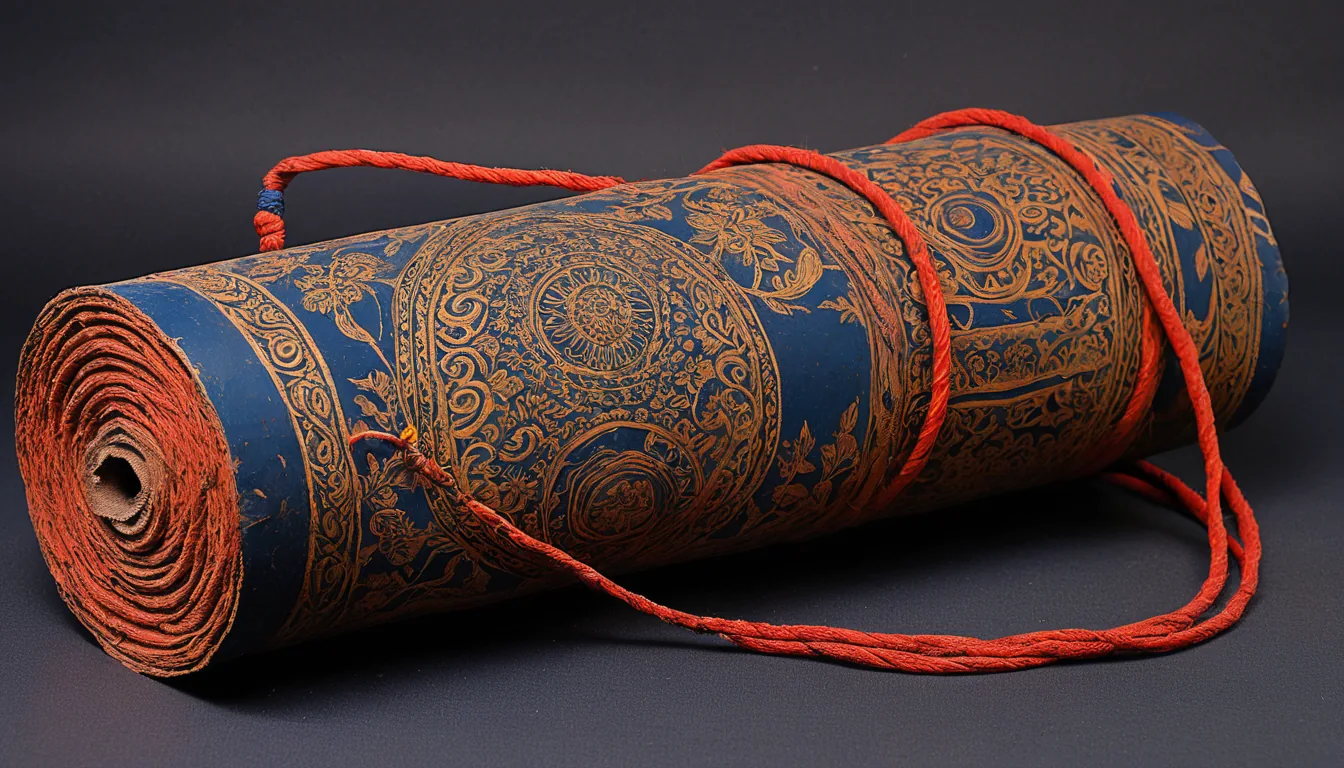
A takrut (ตะกรุด) is a Thai amulet made from a thin sheet of metal, palm leaf or a similar material, inscribed with sacred letters and diagrams and rolled into a long, hollow tube [2], [1]. It is threaded on a cord or chain and worn at the neck, waist or upper arm [4], [5]. Scholars Chris Baker and Pasuk Phongpaichit call it the most common of the yantra devices in the Thai epic Khun Chang Khun Phaen [5].
Key facts
| Fact | Detail | Source |
|---|---|---|
| Thai name | ตะกรุด (RTGS ta-krut); classifier อัน | [2] |
| Basic form | Inscribed sheet rolled into a long, round, hollow tube | [2], [4] |
| Usual materials | Gold, nak (red gold), silver, copper, tin or lead; also palm leaf, animal hide and bone, and bamboo | [4], [2], [3] |
| Typical size (1964) | About 2 inches long; shortest about half an inch; no fixed standard | [4] |
| Inscription | Yant (yantra), usually Pali in Khom script, often abbreviated | [5], [4] |
| How worn | Necklace, sash over the right shoulder, armlet or girdle; often several tubes on one cord | [4], [5] |
| Named sets | Takrut thon (1 tube), sam kasat (three metals), solot (16 tubes) | [17], [3], [1] |
| Word origin | Unknown; compared with Isan katut and Lao ກະຕຸດ | [2], [3] |
What does takrut mean?
The Thai word ตะกรุด is a noun. Thai Wiktionary defines it as a kind of charm made of metal, palm leaf or similar, usually inscribed with incantations and rolled into a long, round, hollow shape [2]. Variant spellings include กะตรุด, กะตุด and กระตรุด [2].
Nobody knows for certain where the word comes from. Thai Wiktionary marks the origin as unknown and compares the Isan word katut (กะตุด) and the Lao ກະຕຸດ [2]. A 2020 Thairath report, drawing on Silpakorn University lecturer Kangwan Khatchima, says the word's origin is still unclear. It adds that the Khmer call such a charm katha (กถา) [3].
Thai writers place the takrut inside a larger family of sacred objects. The folklorist Phya Anuman Rajadhon wrote in 1964 that Thai charms and amulets are called collectively khawng khlang, which he translated as "sacred, potent objects" [4]. He divided them into four traditional classes. The takrut belongs to the third, khruang pluk-sek: made objects that must pass through a consecration rite before they are regarded as charms [4]. Thai sources report beliefs that takrut are associated with khong kraphan chatri (invulnerability), khlaeo khlat (escaping harm) and metta mahaniyom (goodwill). A Prince of Songkhla University library page on southern beliefs lists them [17], and Thai Wikipedia, which cites no references, says the same [1]. These are reported here as beliefs, not as properties of the object.
Takrut in other languages
Readers writing in Malay may meet the word tangkal, which Kamus Dewan defines as an object used to ward off misfortune, glossed as azimat, an amulet [14]. English spellings vary; one UK museum catalogues its example as a "takrud" [11].
What is a takrut made of?
The classic takrut is a small sheet of metal. Phya Anuman Rajadhon lists gold, nak (red gold), silver, copper, tin and lead, cut to the desired size [4]. Baker and Pasuk describe it as "a sheet of thin, pliable metal such as tin or gold" [5]. Thai Wikipedia, which cites no references, gives much the same list: gold, silver, nak, lead and other alloys [1].
Other materials come from sources with references. The 2020 Thairath report lists animal skin, animal bone and sheets of brass, copper or lead as early materials, and says the bullet takrut (ตะกรุดลูกปืน) appeared only a few decades ago [3]. The dictionary definition names palm leaf [2]. Phya Anuman notes a bamboo twig hollowed out wide enough to be strung [4].
Thai Wikipedia, which cites no references and is therefore attributed here, adds these details:
- Palm leaf (ใบลาน), cut into sheets and soaked in water before rolling [1].
- Animal hide, including snake and leopard skin [1].
- Bone or horn, such as elephant bone or the horn of white (albino) cattle, เขาวัวเผือก [1].
It also links the bullet form to the saying "a mother does not kill her child" (แม่ไม่ฆ่าลูก) [1].
Hide takrut and tiger skin
The tiger-forehead-skin takrut (ตะกรุดหนังหน้าผากเสือ) is a hide type covered in the Thai press. A September 2026 Naewna report says it is made from a piece of skin from a tiger's forehead [8]. Following old manuals, the maker first asks forgiveness of the tiger's spirit, then inscribes the skin with yant from the Phichai Songkhram war manuals and rolls it [8]. The same report notes that tigers are a protected species. It advises buyers to check provenance, because fakes and ordinary tiger skin circulate [8].
How a takrut is made
Sources describe the same basic sequence, though each teacher's manual varies the details [4].
- Cut the sheet. A small piece of metal (or leaf, or hide) is cut to the size the formula requires [4], [1], [8].
- Inscribe it. The maker writes the letters and figures of a yant on the metal itself or on a small piece of paper [4]. Thai Wikipedia, which cites no references, says an iron stylus (เหล็กจาร) is used on metal [1].
- Roll it. The sheet is rolled into a long, hollow cylinder [4]. Baker and Pasuk describe it as rolled around the cord itself [5].
- Finish it (optional). A takrut may be braided and lacquered; one Daily News column describes braiding in a "crocodile-tooth" pattern with old lacquer [9]. Thai Wikipedia, which cites no references, adds that modern takrut may be bound with sacred thread, coated with jindamani powder (ผงยาจินดามณี), then lacquered or gilded [1].
- Consecrate it. The object is consecrated with formulas (pluk-sek) before it counts as a charm [4].
Some takrut have a second layer. A takrut held by the Museum of Witchcraft and Magic in Cornwall has an outer tube decorated with three images of the Buddha or a monk. Inside is a piece of rolled lead inscribed with a yantra [11]. The museum's record suggests the tube would have been sealed with wax at both ends and worn on a chain at the neck [11].
Binding, lacquer and what collectors look for
Amulet columns describe old takrut partly by their binding. A 2022 Daily News amulet column describes a takrut of Luang Pu Suk with braiding in the "crocodile-tooth" pattern (ลายจระเข้ขบฟัน) and old lacquer [9]. It describes another, by Luang Pho Thop of Wat Phra Phutthabat Chon Daen in Phetchabun, by its standard wrapping pattern, lacquer shrinkage marks and cracks in the candle wax [9].
What is written on a takrut: yant and Khom script
The inscription on a takrut is a yant (ยันต์, yantra). Baker and Pasuk explain that Southeast Asian yant combine geometric figures, pictures of deities and animals, and written formulas [5]. The formulas are usually in the Pali language, written in Khom script, and often abbreviated. Sequences of numbers, also in Khom, may be added [5].
Khom Thai script (อักษรขอมไทย) descends from Old Khmer within the Brahmi family and has been used from about 1400 CE for Pali, Sanskrit and Thai, including in incantation books (ตำราคาถาอาคม) and yant diagrams [6]. Khom is the most common script on yant but not the only one [5]; the Thairath report says Lanna writers may use their own script [3].
Phya Anuman explains why Khom persisted. Old Buddhist scriptures were written on palm leaf in Khom, and folk tradition came to treat those letters as almost runic [4]. Abbreviated formulas were inscribed in Khom letters, with only the numerals in Thai [4].
Abbreviated formulas and yant manuals
Many inscriptions shrink a long formula to its first letters. Baker and Pasuk describe pathamang, writing the first letter of a mantra or formula, usually in Pali or old Khmer. They call it basic training for making yantra [5]. Phya Anuman calls the abbreviated word "the core of the heart" [4], and Baker and Pasuk call these shortened forms hua jai, "heart formulas" [5]. A formula written on many yant and takrut is na mo phut tha ya (the five-Buddhas katha), which the 2020 Thairath report glosses as homage to the Buddha [3], [4].
Yant patterns were kept in manuscript manuals. Phya Anuman wrote that most were "in private possession". He added that nobody could make yant effectively from the books alone without instruction from a teacher [4]. The Princess Maha Chakri Sirindhorn Anthropology Centre's manuscript archive gives an example. A white folding book (สมุดไทยขาว) from Wat Tha Phut, Nakhon Pathom, records how to make charms. Its personal yant of Luang Pho Kaeo is written in Khom Thai letters in Pali [7].
The inscribing rite
Phya Anuman gave a short outsider's account of drawing a yantra. After purification, the maker invokes the Triple Gem, Hindu deities, rishi (hermit sages), parents and teachers. He then holds his breath while reciting set gatha and must not lift his writing tool until certain lines are complete [4]. He called this "an imperfect statement of a layman" [4]. The Thairath report likewise says the most important element is the person who inscribes the characters, since chants are recited during the rite [3].
How to wear a takrut
A takrut is made to be worn on the body. Phya Anuman lists the main ways [4]:
- On a gold or silver chain, or a cotton string, as a necklace.
- On a chain over the right shoulder, worn like a sash.
- As an armlet.
- As a girdle at the waist.
The Thairath report quotes its Silpakorn lecturer naming two placements: hung at the neck, or made into a cord worn as a belt at the waist [3]. Thai Wikipedia, which cites no references, names the same two (คล้องคอ and คาดเอว) and adds that the tubes lie side by side in a horizontal row [1].
Takrut are often worn several at a time. A large yant may be too big for one small sheet, so it is spread across a set of uniform tubes on one chain [4], [5], usually 3, 5 or 7 [4].
Customs reported around wearing
Wearing customs are reported as belief, and they vary by teacher. The 2026 Naewna report says owners of a tiger-forehead takrut are expected to keep the Five Precepts and make merit [8]. Baker and Pasuk point out that in Khun Chang Khun Phaen the hero takes off all his protective devices before making love to Wanthong. They cite it as an example of how women sometimes figure as a threat to the power of such lore [5].
Takrut types and names
Takrut are named by the number of tubes, the material, the formula, or the maker. The table lists types named in the sources consulted, each backed by at least one source other than Thai Wikipedia.
| Name | Thai | What it is | Source |
|---|---|---|---|
| Takrut thon | ตะกรุดโทน | A single tube | [17], [1] |
| Takrut sam kasat | ตะกรุดสามกษัตริย์ | A takrut made with three kinds of metal; the Songkhla page lists silver, gold and copper plates | [17], [1], [3] |
| Takrut solot | ตะกรุดโสฬส | Sixteen tubes; the old name for the sixteen-takrut strap on the Naresuan statue | [3], [1] |
| Salika | — | A very tiny takrut, named after the mynah bird | [4] |
| Takrut prasom net | — | A tiny takrut that, per Phya Anuman, some authorities say is the proper name for one placed at the eye | [4] |
| Tiger-forehead-skin takrut | ตะกรุดหนังหน้าผากเสือ | Inscribed tiger forehead skin, rolled | [8], [17] |
| Bullet takrut | ตะกรุดลูกปืน | Made from a bullet casing | [3], [1] |
| Chan Phen takrut of Luang Pu Suk | ตะกรุดจันทร์เพ็ญ | A takrut attributed to Luang Pu Suk, described with crocodile-tooth braiding and old lacquer | [9] |
Salika and prasom net
Phya Anuman described the salika as a very tiny takrut, named with the Pali word for the mynah, a sweet talker in folk tales [4]. He recorded the custom of holding it between the teeth, linked in belief to sweet speech [4]. When a tiny form is inserted on the inner lower eyelid, he added, some authorities say it is more correctly called takrut prasom net, "takrut of meeting with the eyes" [4].
What does Maha Rangap mean?
In the compound name "Takrut Maha Rangap" (ตะกรุดมหาระงับ), maha (มหา) means "big, great" [16] and rangap (ระงับ) means to restrain, suppress or calm [15]. We found no independent account of a specific Maha Rangap takrut, so this entry gives only the meaning of the name.
Luang Pu Suk's takrut
Luang Pu Suk's takrut appear in several Thai press reports [3], [9]. Thairath identifies him as Phra Khru Wimon Khunakon (Suk Kesaro) of Wat Pak Khlong Makham Thao, Chai Nat, born BE 2390 (about 1847) and died 23 December BE 2466 (1923), aged 76 [10]. Prince Chumphon (กรมหลวงชุมพร) asked to become his disciple, and the report traces a Luang Pu Suk takrut to the prince's son [3].
History of the takrut
Baker and Pasuk place the takrut before the modern Buddha amulet, which they say grew partly out of it [5], but its exact origins are unclear. The 2020 Thairath report surveys the evidence [3]:
- Angkor. Reliefs at Angkor Wat show soldiers of Suryavarman II wearing long, stick-like objects that the report compares to takrut, calling this the oldest known evidence [3].
- Roots. The report says takrut may have Brahmanical roots that remained alongside Buddhism [3]; Baker and Pasuk trace such practices partly to the Atharva Veda [5].
- Ayutthaya. The report links the transfer of Khmer learning to Ayutthaya's capture of Nakhon Thom (Angkor Thom) under Chao Sam Phraya [3].
- Literature. The report cites passages in Khun Chang Khun Phaen and the Rama II play Khawi in which characters prepare charms [3]. Kangwan Khatchima treats the former as the most reliable written source [3].
From war charm to personal amulet
Thai Wikipedia, which cites no references, says early takrut were large, thick tubes made for warfare, later shrinking to personal charms, some small enough to be inserted into the body [1].
Baker and Pasuk argue that the modern Buddha amulet grew partly out of the takrut, combining the votive tablet's Buddha image with "the convenient portability of a takrut" [5].
The Naresuan statue and the takrut solot
The statue of King Naresuan at Naresuan University in Phitsanulok, dated BE 2536 (1993) in the Thairath report, wears a shoulder strap of sixteen takrut, which the report says the ancients called takrut solot [3]. Kangwan cautions that there is no evidence King Naresuan carried amulets [3].
Takrut today
Takrut are still made today, and not only by monks. In August 2025 Naewna reported that a police officer and sak yant teacher in Ayutthaya, Ajarn Od Phutthawet, had hand-made a Thai-flag takrut to give to soldiers serving on the border [12].
Not every takrut is a charm. Phya Anuman noted in 1964 that some ornaments are made in takrut shape purely for adornment [4]. In 2009 Culture Minister Teera Slakphet asked officials to study Thai-patterned takrut as tourist souvenirs, which he said need not be consecrated [13].
For takrut series that our index tracks, see the observed listing prices.
Where to see pieces like this — Our sister shop, Shogun X Amulets, has a search page for takrut items: https://shogunxamulets.com/?s=takrut&post_type=product. Disclosure: Shogun X Amulets and ThaiAmuletExchange.com are run by the same group.