
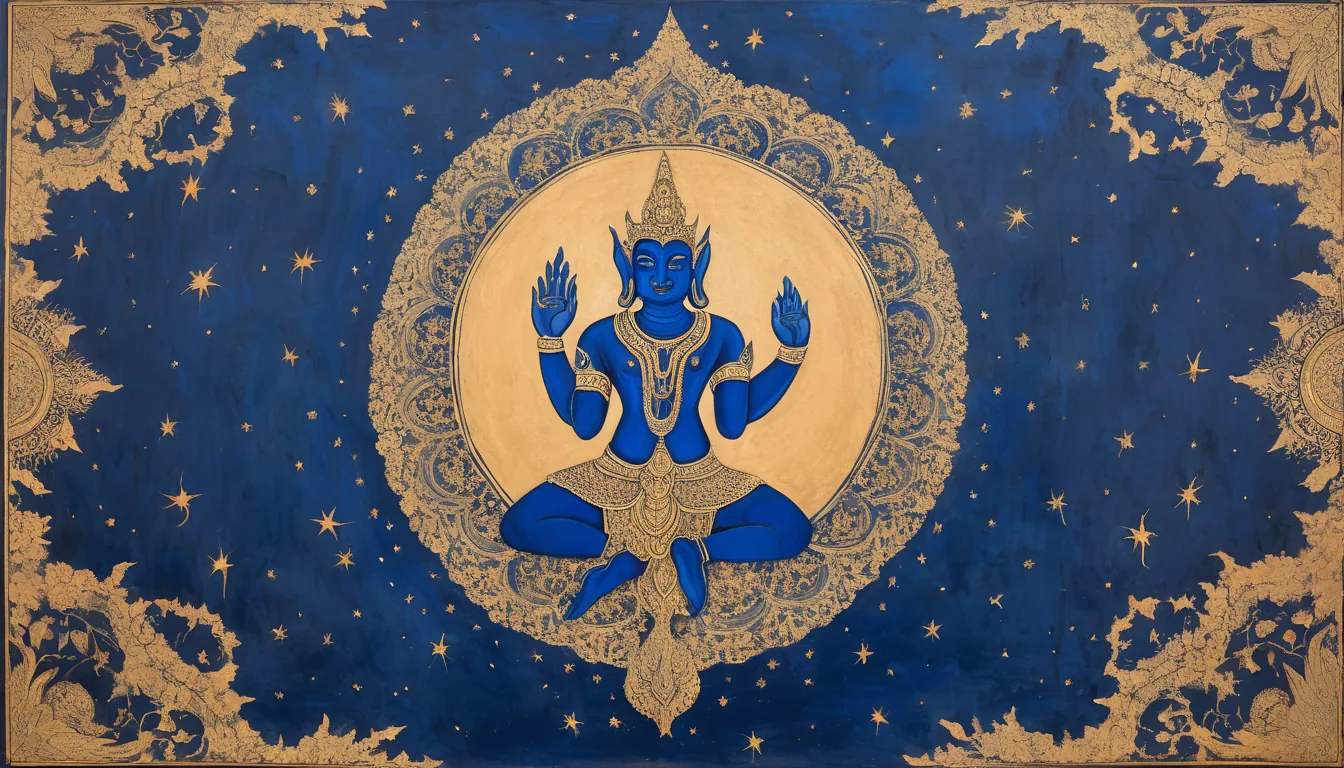
Phra Rahu (พระราหู) is the Thai name for Rahu, the asura of Hindu and Buddhist mythology who is said to swallow the Sun or Moon and so cause eclipses; in astronomy his name is attached to the Moon's ascending node, one of the two points where the lunar orbit crosses the ecliptic [1], [3]. In Thai astrology he is one of the nine planetary deities, marked by the numeral ๘ (eight) and linked with people born on Wednesday night [2]. In Thailand he is the subject of temple worship, most famously at Wat Sisa Thong in Nakhon Pathom, and of carved coconut-shell amulets [12], [14].
Key facts
| Fact | Detail | Source |
|---|---|---|
| Thai name | พระราหู (Phra Rahu); Chinese 羅睺 / 罗睺, also 拉胡 | [2], [6] |
| Mythic origin | Asura who drank the nectar of immortality and was cut in two; head = Rahu, body = Ketu | [1], [11] |
| Astronomy | Name of the Moon's ascending node; the nodes circle the sky every ~18.6 years | [1], [3] |
| Thai astrology | Number ๘; deity of those born on Wednesday night; direction northwest | [2], [15] |
| Best-known temple | Wat Sisa Thong, Nakhon Chai Si district, Nakhon Pathom (Huai Tako [12], [14] or Sisa Thong [16] subdistrict) | [12], [14], [16] |
| Best-known amulet | Coconut-shell Rahu of Luang Phor Noi, Wat Sisa Thong | [14], [18] |
| Material rule | Shell from a coconut with one "eye" (กะลาตาเดียว) [14], [18] or none (กะลาไม่มีตา) [18] | [14], [18] |
| Scholarly view | Rahu's image shifted from ill omen to bringer of fortune in 1997–2017 | [9] |
Who is Rahu in Hindu mythology?
The best-known story comes from the Puranic account of the churning of the ocean (Samudra Manthana). When the god Vishnu, disguised as the enchantress Mohini, handed out the nectar of immortality (amrita), the asura Svarbhanu slipped in and drank some. The Sun and Moon exposed him, and Vishnu cut off his head with his discus, the Sudarshana Chakra [1].
Because he had already tasted the nectar, both parts survived. The head became Rahu and the body became Ketu, and both were given planetary status [1]. The myth explains eclipses as Rahu's revenge: he chases the Sun and Moon and swallows them, but since he has no body, they slip out again through his throat [1].
A Thai press retelling follows the same outline. It names the asura Surinthara Rahu (สุรินทรราหู) and says Narayana (Vishnu), after taking the form of an apsara, threw his discus and cut Rahu's body in two, the upper half becoming Rahu and the lower half Phra Ketu [11]. Thai Wikipedia gives both that waist-cut version and the Hindu neck-cut version, and also records a separate Thai origin story in which Shiva ground twelve phi khomot ghost heads (หัวผีโขมด 12 หัว) into powder, wrapped it in gold or bronze-gold cloth, sprinkled it with amrita and created Rahu. This is given as the reason Rahu's planetary strength is reckoned as 12 [2].
Rahu in Buddhist scripture
Rahu also appears in the Pali Canon. In the Candima Sutta (Samyutta Nikaya 2.9), the moon deity Candima is seized by "Rahu, lord of Asura" and calls on the Buddha for refuge. The Buddha addresses Rahu in verse and asks him to release the Moon [7].
Rahu lets go and runs, trembling, to the asura lord Vepacitta (spelled Vepacitti in other Pali and Thai texts) [1], [2], [7]. He explains that if he had not obeyed, his head would have split into seven pieces [7]. The Suriya Sutta (SN 2.10) tells the same story about the sun deity Suriya [8].
Both texts belong to the paritta, the protective chants that monks recite in ceremonies [7]. English Wikipedia notes that their verses are still used in Buddhist liturgy as protective prayers [1].
What causes an eclipse? The astronomy behind Rahu
The Moon's orbit is tilted about 5.14° to the ecliptic, the plane of Earth's orbit around the Sun. The two crossing points are the lunar nodes. In Hindu astronomy the ascending node is called Rahu and the descending node Ketu; medieval European astronomers called them the dragon's head and tail (caput and cauda draconis) [3].
A lunar eclipse can happen only when a full Moon is near a node, and a solar eclipse only when a new Moon is [3]. This is why eclipses do not happen every month. They cluster in "eclipse seasons" about six months apart [3]. NASA notes that every year has two to five solar eclipses [4].
The nodes are not fixed. They drift backwards around the sky, completing a circuit in about 18.6 years [3]. A related cycle, the saros of about 6,585.3 days (18 years, 11 days and 8 hours), equals 223 synodic months. After one saros, eclipses repeat with very similar geometry [4]. English Wikipedia ties Rahu and Ketu's roughly 18-year cycle to this saros [1].
Recent and upcoming lunar eclipses
NASA's eclipse table lists a total lunar eclipse on 3 March 2026 and a partial one on 28 August 2026 [5]. The next lunar eclipses are penumbral, on 20 February, 18 July and 17 August 2027. The next total lunar eclipse is listed for 31 December 2028 [5]. Thai writers use the folk phrase "Rahu swallows the Moon" (ราหูอมจันทร์) both for a lunar eclipse and for a type of Rahu amulet [11], [14].
Rahu in Chinese astronomy (罗睺)
In Chinese, Rahu is 羅睺 (simplified 罗睺), one of the Nine Luminaries (九曜) paired with Ketu (計都) [6]. Chinese Wikipedia notes that sources disagree on which node he stands for. The Qi Yao Rang Zai Jue and Johann Adam Schall von Bell treat him as the ascending node, while Shen Kuo treats him as the descending node [6].
Phra Rahu in Thai astrology: Wednesday night and the number 8
Thai Wikipedia states that Rahu is the deity of people born on a Wednesday at night, and that Thai astrology writes him with the numeral ๘ [2]. He is placed in the northwest, and Thai sources describe his body as dark (นิล) tinged with bronze-gold [2]. In astrology he is counted as a friend of Saturn and an enemy of Mercury [2].
Thai Wikipedia describes his traditional Thai image this way: a dark (นิล) figure tinged with bronze-gold, shown as a half-body, full body, or half-asura half-naga, with a clenched mouth (ปากขบ), bulging eyes and two arms. He holds a mace, wears a gourd-shaped crown and rides a garuda [2]. Hindu images in the same entry instead have a dark-blue body (สีนีล), four arms and a tiger or lion as his mount [2].
What does "Rahu moving" (ราหูย้าย) mean?
Thai astrologers publish forecasts when Rahu "moves" into a new zodiac sign. A 2022 Daily News report said Rahu changes sign about every 18 months [15]. It reported a move from Taurus to Aries at 02:24 on 30 March 2022 [15]. That pace roughly matches the ~18.6-year circuit of the lunar nodes divided across twelve signs [3]. A 2017 Post Today piece gave a different figure (once a year) [16], so the popular press is not consistent.
How Rahu changed from omen to object of worship
A 2019 study in a Kasetsart University humanities journal by Prasert Runra (ประเสริฐ รุนรา, Thammasat University) traces how Rahu's meaning shifted in Thai society between 1997 and 2017 [9]. Rahu was traditionally linked to misfortune. That older view shows in two practices: rituals to drive him off during solar eclipses, and rites to ward off his influence when astrology said he was active [9].
The study argues that in the same period Rahu was recast, partly by sculptors and image-makers, as a figure associated with fortune and prosperity. Large Rahu statues in many forms were made in central and eastern Thailand [9]. This is a finding about belief, not a claim about effects.
A 2022 study by Pattaradhorn Sanpinit and Somphonnut Tansrisuk (สมพรนุช ตันศรีสุข) examined 51 Rahu stories that appeared in Thai print (18 in books and magazines) and digital media (33 on websites, Facebook and YouTube) between 2546 and 2565 BE (2003–2022) [10]. It found that creators cut, adapted and invented episodes from Hindu, Buddhist and Thai literary sources to present Rahu as a deity fit for Buddhist veneration [10].
Folk eclipse customs are older. A 2024 Thairath feature describes villagers beating clappers, striking wood (ตีเกราะเคาะไม้) and setting off firecrackers during eclipses to drive away evil. It also describes beliefs that the weekday of an eclipse foretold events for the realm [11]. It records an older Southeast Asian name for an eclipse, "the frog eats the Moon" (กบกินเดือน) [11].
Wat Sisa Thong: the Phra Rahu temple in Nakhon Pathom
Wat Sisa Thong (วัดศีรษะทอง) is in Nakhon Chai Si district, Nakhon Pathom province; Thairath places it in Huai Tako subdistrict [12], [14], while Post Today places it in Sisa Thong subdistrict [16]. Thairath reports that it was built in the early Rattanakosin period and was formerly called Wat Hua Thong [12]. A 2022 Daily News report called it the original source (ต้นตำรับ) of Rahu worship [15].
Its fame rests on Luang Phor Noi, a former abbot known for his Rahu amulets [12], [14]. A 2002 (2545 BE) Thammasat University anthropology master's thesis titled พระราหู: “ประเพณีประดิษฐ์” แห่งวัดศีรษะทอง (Phra Rahu: The "Invented Tradition" of Wat Sisa Thong), by Ekarin Phuengpracha (เอกรินทร์ พึ่งประชา), is listed in the references of both Kasetsart studies [9], [10]. Its title frames the temple's Rahu worship as an "invented tradition", that is, a comparatively recent practice.
What visitors find at the temple
A Post Today writer who visited on 25 November 2017 described the Rahu image housed in a sala (open pavilion), with large-print prayers displayed for visitors [16]. The temple sold a set of eight all-black offerings for 300 baht (2017 price). The set included black grapes, black coffee, century eggs, black jelly, black sticky rice, grass jelly (เฉาก๊วย), black soda, and black beans or cookies [16]. One table held items to take home and another held items left as offerings [16].
The same report said crowds peak on Wednesdays and Sundays and in July and August [16]. Thairath listed the temple as open daily from 08:30 to 17:00 except on Buddhist holy days (2022 listing) [12]. Check current hours before visiting.
The 2017 suspension
In early October 2017, Rahu worship at Wat Sisa Thong was paused. Post Today reported that a temple staff member said the Nakhon Pathom provincial sangha had asked the temple to close the Rahu pavilion and pause offering sales amid pressure over non-Buddhist deity worship; the report also quoted Order 8/2560 (30 September 2017) of Somdet Phra Phutthachinnawong, Chief of the Central Monastic Jurisdiction, which ordered temples to remove signs advertising amulet consecrations or guru-monk powers and banned selling amulets inside ordination halls (อุโบสถ) [16]. Earlier reports had described the image being caged and draped with a monk's robe. By late November 2017 worship had resumed and nothing covered the statue [16].
Other places in Thailand associated with Rahu worship
A 2022 Thairath guide listed five sites, four of them besides Wat Sisa Thong [12]:
- Rahu Tewalai (ราหูเทวาลัย), Bangkok, near the Kaset–Nawamin intersection.
- Wat Tha Mai (วัดท่าไม้), Krathum Baen, Samut Sakhon.
- Wat Traimit Witthayaram, Bangkok, where an image shows Narayana riding Garuda and standing on Rahu.
- Wat Khun Chan (วัดขุนจันทร์), Thonburi, Bangkok, which has a Rahu shrine.
How Phra Rahu worship is done: offerings and chants
Thai press describes the custom as an offering of black items, usually eight or twelve kinds [13], [15]. Typical examples include black coffee, cola, grass jelly, black jelly (เปียกปูน) and chocolate [13]. One astrologer quoted by Daily News advised facing northwest, Rahu's direction [15]. Practice varies. A 2022 Thairath article on Rahu worship during that year's Loy Krathong lunar eclipse said not to light incense or candles [13], while the Daily News steps include incense among the offerings [15].
What is the Phra Rahu mantra?
There is no single fixed "Rahu mantra." Press guides list several chants: a Rahu worship prayer, the Suriya-bappa and Chantha-bappa verses, an offering verse, and a Rahu prayer recited twelve times [13], [15]. The Pali verses of the Candima and Suriya Suttas, in which the Buddha asks Rahu to release the Moon and Sun, are a separate, canonical text used as protective chanting [7], [8].
Coconut-shell Rahu amulets (ราหูกะลาแกะ)
The best-known Rahu amulet is the carved coconut-shell Rahu (พระราหูกะลาแกะ). It usually shows Rahu swallowing the Sun or Moon, a type called ราหูอมจันทร์ [14]. Thai sources say the traditional rule calls for a shell from a coconut with only one "eye" (กะลาตาเดียว) [14], [18] or with no "eyes" at all (กะลาไม่มีตา) [18].
Luang Phor Noi of Wat Sisa Thong
Luang Phor Noi Khanthachoto (หลวงพ่อน้อย คันธโชโต, lay name Noi Nawarat) was born on 14 February 2435 BE (early 1890s CE) in Sisa Thong subdistrict, the youngest of five children of Nai Ma and Nang Mi Nawarat [14]. Thairath reports that his father was a traditional healer and ritual specialist of Lao descent whom villagers called "Pho Mo" [14]. Noi was ordained on 14 April 2456 BE (1913) at age 21 at Wat Khae, later moved to Wat Sisa Thong (where he studied lineages passed down from Luang Phor Trai and Luang Phor Li), became its abbot after Phra Athikan Choi disrobed, and finally served as subdistrict ecclesiastical head [14].
His Rahu and the ox charm (Phra Kosulap, วัวธนู) are the works he is best known for [14]. Daily News credits the carving of one celebrated piece to a craftsman called "Lung Si Yai" (ลุงศรีใหญ่) [18]. The sacred script on his Rahu is in Luang Phor Noi's own hand [18], [19].
How the shells are made
Thairath describes an old Lao method: it first states that the one-eyed shell is carved into Rahu swallowing the Moon alone, and in the next sentence states that Luang Phor Noi had disciples carve one-eyed shells into both Rahu swallowing the Sun and Rahu swallowing the Moon [14]. The yantra Suriya-prapha is written during a solar eclipse and Chantha-prapha during a lunar eclipse [14]. Because lunar eclipses happen only once or twice a year, and some years have none, production is tied to the eclipse calendar [11], [14]. Before writing, the maker sets out offerings to his teachers and purifies himself [14].
The same timing rule is reported for Kruba Nanta of Wat Thung Man Tai, Lampang, who was born in 2415 BE and died in 2504 BE (1961) at 90 [17]. A 2018 Post Today column says he inscribed his shells in a ritual pavilion built in the middle of the Tui River (แม่น้ำตุ๋ย) behind his temple, writing preliminary letters on an auspicious day and adding the final character during the eclipse itself, stopping as soon as the eclipse ended [17]. It also says he made Rahu as single pieces and as Suriya-prapha / Chantha-prapha pairs [17]. Finishes included black lacquer (รัก), vermilion (ชาด) with gold leaf, or plain shell [17]. The same column claims Luang Phor Noi came to Kruba Nanta to learn more of the craft; this is a single press account [17].
How collectors identify a Luang Phor Noi coconut-shell Rahu
Press columns that photograph genuine pieces point to a few features:
- Handwritten script. The inscription is in Luang Phor Noi's own hand, so collectors study his handwriting [19].
- Yantra marks. The back carries the letter ฤ and the formula na 12, mo 21 (นะ 12 โม 21) [14], [18].
- Surface. Genuine shells are described as dry and aged [14].
- Imitations. Daily News warns that the more a type is worth, the more copies circulate, and that early pieces in intact condition are hard to find [18], [19].
These points are aids, not proof. For modern Rahu pieces, our index tracks observed listing prices for a Phra Rahu series of 2566 BE (2023) [20].
Where to see pieces like this — Our sister shop, Shogun X Amulets, has a page on Phra Rahu: https://shogunxamulets.com/?s=rahu&post_type=product. Disclosure: Shogun X Amulets and ThaiAmuletExchange.com are run by the same group.