
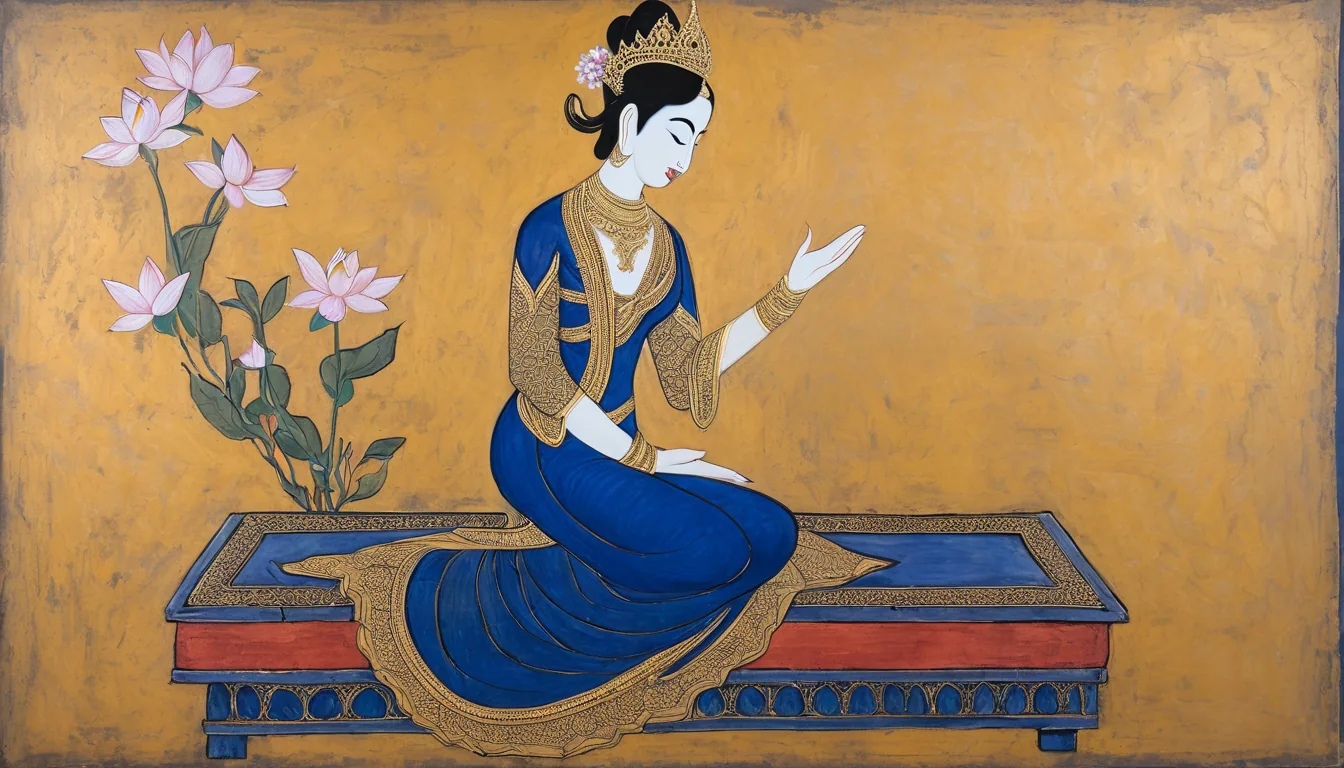
Nang Kwak (นางกวัก, "the beckoning lady") is a female figure of Thai folk religion, shown as a woman in Thai dress, seated, with her right hand raised in a beckoning gesture [3], [2]. Her image is kept on altars in shops and market stalls, and the shopkeepers and vendors who worship her believe she draws customers to a business [3], [2]. Her origin is told in several different legends: a Buddhist-era tale of a merchant's daughter, a tale linked to the Ramakien, and an older account of a Tai ancestral spirit [3], [2].
Key facts
| Fact | Detail | Source |
|---|---|---|
| Name | นางกวัก: nang "lady" + kwak, the Thai word for beckoning with the hand | [3], [2] |
| Usual form | Seated woman in Thai dress, right hand raised, left hand on her lap or on a bag or pot of money | [2], [3], [5] |
| Main legends | Nang Suphawadi of the Buddha's time; daughter of Pu Chao Khao Khiao (ปู่เจ้าเขาเขียว); Tai ancestral spirit | [3], [2] |
| Earliest images | Said to date from the Ayutthaya period, in metal, clay or wood | [5], [2] |
| Chinese Wikipedia title | 南卦; its infobox labels her 招财女神 (招財女神), "wealth-beckoning goddess" | [10] |
| Folk game | Lao Khrang villagers in Uthai Thani hold a Nang Kwak spirit game at Songkran, using a kwak weaving tool | [4] |
| Bank mascot | Siam Commercial Bank's "Mae Manee" (แม่มณี), described in 2017 as a "digital Nang Kwak" | [9], [3] |
What does Nang Kwak mean?
The name has two parts. Nang (นาง) means a lady, and kwak (กวัก) names the gesture of beckoning someone with the hand [3], [2]. Al Lim, writing in the Journal of the Siam Society in 2024, translates the name as "The Beckoning Lady" [3].
The word kwak has a second meaning. Among the Lao Khrang people of Uthai Thani, a kwak is a tool used in weaving cloth, made of bamboo or rattan [4]. The study says the Nang Kwak spirit game (see below) is named after the tool used to call the spirit [4].
Nang Kwak origin legends: three versions compared
There is no single, fixed origin story. Lim reconstructed two main narratives from interviews with shopkeepers, online marketplaces and popular songs [3]. Thai Wikipedia gives these two and adds a third [2].
1. Nang Suphawadi, a merchant's daughter in the Buddha's time
In Lim's telling, which English and Thai Wikipedia also give in outline, Nang Kwak was a girl named Suphawadi (สุภาวดี), born in a town called Michikasandhanakara during the Buddha's lifetime [3], [2]. Her family took her with them on trading trips by cart. On one journey she heard a sermon by an arahant (a monk who has reached enlightenment), was moved to devote herself to Buddhism, and the monks blessed her and her family [3], [1].
Lim describes the story as a model for devotees: the girl's piety and her meeting with the monks come before her family's prosperity [3]. Thai Wikipedia adds that an image of her was made for worship after her death [2]. It also says the worship of Nang Kwak has never existed in India, and suggests the story was composed to give the figure age and sanctity [2].
2. The daughter of Pu Chao Khao Khiao
The second story, told in Lim's study and in English Wikipedia, links Nang Kwak to characters from the Ramakien, the Thai version of the Ramayana. Here she is the only daughter of Pu Chao Khao Khiao (ปู่เจ้าเขาเขียว), "Grandfather of the Green Mountain" [3], [6]. Her father's friend, the demon Thao Kok Khanak (ท้าวกกขนาก), has been punished by Phra Ram, and the demon's daughter cannot run her family's trade [3].
Pu Chao Khao Khiao sends Nang Kwak to live with the demon's daughter, and in the story wealthy visitors begin to come to that household [3], [1]. Lim found that vendors most often explained her origins by quoting the opening lines of the popular song Nang Kwak Maha Sane, which call her the one daughter of Pu Chao Khao Khiao [3]. Chants published by Thairath use similar wording [6].
3. A Tai ancestral spirit
Thai Wikipedia lists a third account and cites a 2019 article in the magazine Thang Isan for it. It says Nang Kwak was first honoured as an ancestral spirit of Tai-speaking peoples, remembered as one of the first Tai women skilled at weaving [2]. This version ties her to the Nang Kwak spirit-calling game still played in some Thai villages [2], [4].
How the versions differ
The versions disagree on names, places and details:
| Point | Lim (2024) | English Wikipedia | Thai Wikipedia |
|---|---|---|---|
| Monk(s) in the Suphawadi story | Phra Kuman Kassapa Thera; some versions add Phra Sivali | "Phra Gumarn Gasaba Thera" | Phra Maha Kassapa and Phra Sivali |
| Suphawadi's parents | Not named | Sujidtaprahma and Sumanta | สุจิตตพราหมณ์ and สุมณฑา |
| Demon's punishment | Cursed by Phra Ram; must weave a robe of lotus petals for the future Buddha Maitreya | Pinned to Mount Meru by Phra Ram with a kok tree; robe condition marked "citation needed" | Pinned at Khao Wong Phra Chan by Phra Ram's arrow |
| Demon's daughter | Nang Prachant (นางประจันทร์), too busy weaving the robe to trade | Nang Prachant, too busy weaving to run a business | นางนงประจันทร์, shunned by villagers after trying to free her father |
| What it rests on | Interviews, online marketplaces and popular songs | Cites Ara Wilson (2008) and a Buddha Magic magazine issue | Cites the book ทิพยประติมา (2017) and a 1999 book on Lopburi |
| Source | [3] | [1] | [2] |
Thai Wikipedia places its version of the demon story in Lopburi folk tradition and notes that the demon is called Thao Unarat (ท้าวอุณาราช) in King Rama I's Ramakien [2].
The Nang Kwak spirit game and the weaving tool
Separate from the shop figure, "Nang Kwak" is also the name of a village spirit game. A 2022 study in the Suratthani Rajabhat Journal by Kitsada Sresuksai and Saran Nakrob documents it among the Lao Khrang of Ban Khok Mo, Thap Than district, Uthai Thani [4]. The study's abstract says the Lao Khrang settled in Thailand in the reign of King Rama III [4].
The game is held at Songkran, when villagers believe ancestral spirits are allowed to return home [4]. A puppet is built from a kwak weaving tool and a pole and dressed in a long-sleeved white shirt [4]. Four or five players sing, clapping the rhythm without instruments, until a spirit is believed to enter the puppet [4].
Questions are then put to the spirit, which in the Nang Kwak game answers by writing letters on the ground [4]. Offerings include four bunches of flowers, 12 incense sticks, rice, salt, betel and old coins [4]. The researchers record that the community plays it for entertainment only [4]. Thai Wikipedia mentions a similar Nang Kwak performance among Thai Phuan communities in Lopburi and Sukhothai [2].
What a Nang Kwak statue looks like
The standard Nang Kwak statue is a woman seated with her legs folded to one side (พับเพียบ) [5], [2]. She wears Thai dress, often with a crown or headdress (chada), and her right hand is raised to about shoulder height in the beckoning gesture [3], [5]. Her left hand rests on her lap or at her side, or holds a bag or pot of money [2], [3]. Thairath notes that the money bag is said to carry inscribed sacred verses [5].
The height of the hand
A widely repeated rule concerns the raised hand. In Thai popular belief, a hand held above the mouth is read as "more than enough to eat" (กินไม่หมด), while a hand below the mouth is read as "not enough to eat" (กินไม่พอ) [5], [2]. Lim records a ritual specialist giving the same rule in a 2018 Amarin TV episode, while another collector in that episode said the hand height is simply the sculptor's choice [3].
Regional and modern forms
- Lanna form: Thai Wikipedia describes a northern version that raises the left hand above the ear and carries a money bag on her back [2].
- Nang Koi (นางโกย): a related figure with both hands raised in a scooping action (koi) instead of beckoning [3].
- Tuinui ("chubby"): a plump statuette from Khruba Ariyachat of Wat Saeng Kaeo Pothiyan, Chiang Rai, which Lim found to be a vendor favourite [3].
- Modern variants: Thai Wikipedia lists glamorous dress, two or more raised hands, sunglasses and designer handbags [2].
Nang Kwak is often compared with Phosop, the Thai rice goddess. English Wikipedia notes that unlike Phosop, Nang Kwak does not carry a rice sheaf on her right shoulder [1], [12].
Nang Kwak amulets, statuettes and yantra cloths
Nang Kwak appears in three main forms: statuettes, small amulets and printed yantra cloths (pha yant) [3], [1]. Lim found statuettes far more common than amulets. At Bangkok's Tha Prachan amulet market in 2023 vendors mostly offered statuettes and yantra cloths, while amulets turned up at Chatuchak market [3]. The amulets he measured were about 12 × 8 mm and 30 × 20 mm, each showing a seated figure with the right hand raised [3].
Many of Lim's interviewees disliked calling Nang Kwak amulets phra khrueang (พระเครื่อง), because the word phra is associated with monkhood [3].
Makers and temples
Collectors care about who made a figure and where. Lim's interviewees named Luang Pho Im (1863–1937) of Wat Hua Khao, Suphan Buri, as one well-known source [3]. Separately, Thairath reported in 2022 that a brass Nang Kwak at Wat Hua Khao, 18 by 34 inches, stands in a hall named for a former abbot, Luang Pu Im Siripunyo, and is revered by villagers; the report credits the figure to Phra Ajarn Direk [8]. The report does not say whether this abbot is the Luang Pho Im (1863–1937) named by Lim's interviewees.
For Khruba Ariyachat's Tuinui statuettes, vendors told Lim that a temple stamp on the base shows the piece was made at the temple [3]. Chants for honouring Nang Kwak are credited to several monks, including Luang Pho Te of Wat Sam Ngam, Nakhon Pathom, and Luang Pho Doem of Wat Nong Pho, Nakhon Sawan [6], [3].
Age claims and prices
Lim's fieldwork shows why age claims need checking. Lim (2024) reports that in 2023 a Chatuchak vendor asked 3,800 Thai baht (THB) for a newer Nang Kwak amulet and 15,000 THB for one said to be 200 years old [3]. Lim judged the age claim unlikely, because the site named as its origin, Mrigadayavan Palace, was built under King Rama VI (1910–1925) [3]. Lim also reports that the Pathum Thani artist Achan Joe sells his revealing-dress statuette for 4,000 THB each, which Lim puts at about eight times the cost of a normal statuette of the same size; Lim does not give the year of that price [3].
For one specific monk-made series, see our observed listing prices.
Where Nang Kwak appears
The most familiar setting is the shop. Lim describes her usually sitting on an altar shelf (hing bucha) at the back of a shop [3]. In his visits he saw no single rule: some owners placed her on the altar, others on a cash register or a table [3].
She also appears in temples. Phosop, Nang Kwak and Phra Mae Thorani are enshrined together at Wat Siri Wattanaram in Bang Phrom, Taling Chan [12]. English and Chinese Wikipedia both record her image at Wat Phra That Ruang Rong in Si Sa Ket [1], [10].
Outside Thailand, Chinese Wikipedia records a statue at 古巖淨苑 in Tai Wai, Sha Tin, Hong Kong, and English Wikipedia lists one at Koon Ngam Ching Yuen, Hong Kong [10], [1]. Lim notes that Vietnamese vendors trade her figures online and that Singapore has become a hub for the Thai amulet trade [3].
Mae Manee, the bank mascot
In 2017 Siam Commercial Bank launched "Mae Manee" (แม่มณี) as the face of its SCB Easy Pay QR-code payment campaign [9]; Lim calls her a cartoon version of Nang Kwak and the mascot of the bank's payment app [3]. Brand Inside reports the bank's marketing chief saying the idea came from mixing a belief with technology, and calls her "a digital-age Nang Kwak" [9].
Nang Kwak offerings and placement customs
Customs vary by teacher, and the sources describe them as matters of personal faith [6], [3]. The commonly reported elements are:
- Direction: the altar or figure faces outward, towards the shopfront [5], [6], [3].
- Daily care: water and offerings every day, and fruit at least once a week [5], [6].
- Incense: nine or 16 sticks according to Thairath, with 16 reserved for higher-ranking deities [5], [6]. One specialist on Amarin TV instead specified five sticks, scented with jasmine or rose [3].
- Red drink: Thairath reports that Nang Kwak is said to favour fragrant things and sweet red drinks (nam daeng) [7]. The paper links red-drink offerings in general to older blood offerings, to red as a lucky colour in Chinese belief, and to the value once placed on sweetness [7].
- Other offerings: the same specialist named coloured water, a bracelet on her right hand, five fruits (pineapple, pumpkin, banana, young coconut and wax gourd) and white or red coconut dumplings [3]. Thai Wikipedia mentions red drinks and garlands [2].
- Height: the specialist said she should sit higher than eye level, and one collector said she should not sit level with Buddha images [3].
A chant is usually recited after lighting incense; different monks have issued their own versions [6], [3].
Devotees also make thanks offerings. In 2022 Thairath reported that three women hired a likay troupe to perform before the Wat Hua Khao figure as a vow-fulfilment offering [8].
Nang Kwak in Chinese, and the maneki-neko comparison
Chinese Wikipedia titles its entry 南卦 and, in its infobox, labels her 招财女神 (traditional 招財女神), literally "wealth-beckoning goddess". That label is the encyclopedia's own wording [10]. The same entry compares her raised hand with the Japanese 招財貓, the "beckoning cat" [10]. Statuette vendors told Lim that Thai buyers prefer the slim, seated form in Thai dress, while Chinese and Chinese-diaspora buyers tend to choose other versions [3].
English Wikipedia also notes that Nang Kwak shares the beckoning gesture with the Japanese maneki-neko [1]. Among the earliest records of the maneki-neko are an Edo chronicle entry and a Hiroshige print, both dated 1852 [11]. Thai Wikipedia points out that this falls in the reign of King Rama IV, but none of the sources found shows that either figure was copied from the other [2], [11].
When did Nang Kwak images first appear?
The sources do not give a firm date. Thairath and Thai Wikipedia both say the earliest images are thought to date from the Ayutthaya period, as small figures of metal, clay or wood [5], [2]. Both say her cult became more visible under King Mongkut (Rama IV) and King Chulalongkorn (Rama V), as trade grew in Bangkok and provincial towns [5], [2].
Some writers trace her to the rice goddess Phosop, which Thairath reports as one belief among others [5], [1]. Lim links her recent popularity to the growth of Thai wealth cults since the 1990s and to online selling on platforms such as Shopee, Lazada and Facebook [3].
Where to see pieces like this — Our sister shop, Shogun X Amulets, has a search page for Nang Kwak items: https://shogunxamulets.com/?s=nang+kwak&post_type=product. Disclosure: Shogun X Amulets and ThaiAmuletExchange.com are run by the same group.