
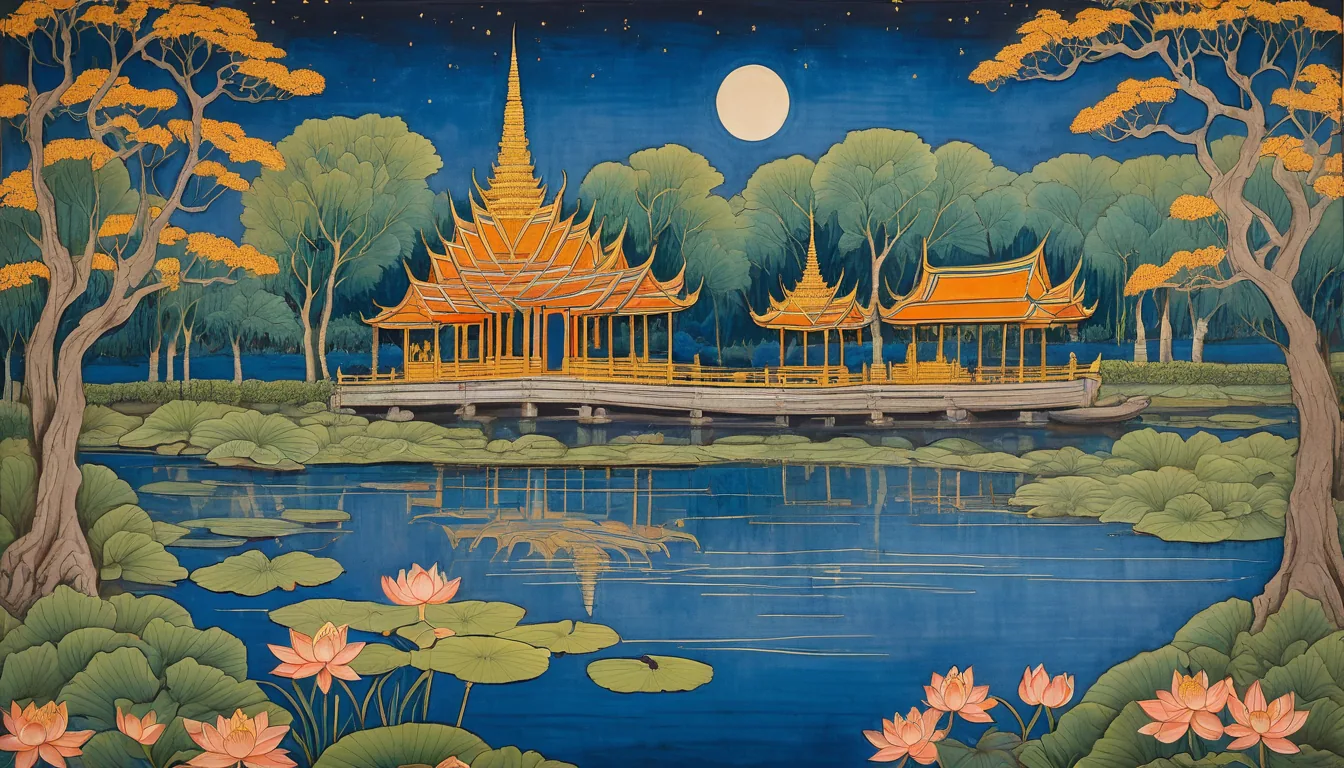
Mae Nak (แม่นาค or แม่นาก), known in full as Mae Nak Phra Khanong (แม่นาคพระโขนง or แม่นากพระโขนง, "Lady Nak of Phra Khanong") or Nang Nak (นางนาก, "Miss Nak"), is a female ghost of Thai folklore set along the Phra Khanong Canal in Bangkok [1] [7]. In the common story, she died with her unborn child while her husband Mak was away on military service, remained at home as a spirit when he returned, and was later subdued at Wat Mahabut [1] [7]. A shrine to her stands inside Wat Mahabut on On Nut Road in Bangkok's Suan Luang district, and the tale has been adapted into dozens of Thai films, stage plays and television series, including Nonzee Nimibutr's Nang Nak (1999) and Banjong Pisanthanakun's Pee Mak (2013) [1] [3] [5] [6].
Key facts
| Fact | Detail | Source |
|---|---|---|
| Names | แม่นาคพระโขนง / แม่นากพระโขนง (Mae Nak Phra Khanong), แม่นาก (Mae Nak), นางนาก (Nang Nak), ย่านาค (Ya Nak, "Grandmother Nak") | [1] [6] [7] [13] |
| Setting | Khlong Phra Khanong in the reign of King Rama III (1824–1851) or King Rama IV (Mongkut) | [1] [7] [11] [17] |
| Spirit category | Phi tai tang klom (ผีตายทั้งกลม), a woman who died in childbirth with the child in the womb | [7] [10] [13] |
| Shrine location | Shrine of Ya Nak (ศาลย่านาค) at Wat Mahabut, 749 Soi On Nut 7 (Sukhumvit 77), Suan Luang, Bangkok | [1] [6] [8] [13] |
| Historical account | K.S.R. Kulap's Siam Praphet article on Amdaeng Nak (อำแดงนาก), daughter of Khun Si and wife of Nai Chum | [1] [7] [12] |
| Forehead-bone panneng | Phraya Thiphakosa's biography of Somdej Toh describing a belt buckle cut from Nak's frontal bone | [1] [11] [13] |
| National Film Heritage | Mae Nak Phra Khanong (1959), Nang Nak (1999) and Pee Mak (2013) | [2] [4] [14] |
What does Mae Nak Phra Khanong mean?
In Thai, the name is spelled แม่นากพระโขนง (with final k, นาก) or แม่นาคพระโขนง (with final kh, นาค) [1] [2] [6] [7]. English Wikipedia glosses แม่นากพระโขนง as "Lady Nak of Phra Khanong", แม่นาก as "Lady Nak" and นางนาก (Nang Nak) as "Miss Nak" [1], while Thailand Foundation notes that Mae (แม่, literally "mother") formerly served as a courtesy prefix for "Miss" or "Lady" [7]. At her Wat Mahabut shrine, visitors call her Ya Nak (ย่านาค, "Grandmother Nak") [6] [10] [13].
Phra Khanong refers to the canal-side area along Khlong Phra Khanong in eastern Bangkok; under modern municipal boundaries, Soi Sukhumvit 77 (On Nut Road) lies in Suan Luang district, separated from Phra Khanong [1] [3] [6] [7]. In Thai folk taxonomy, Mae Nak is a phi tai tang klom (ผีตายทั้งกลม), the spirit of a woman who dies in pregnancy or labour with the infant still inside her womb, and Time Out Bangkok notes that she is regarded as a ghost (phi) rather than a deity [7] [8] [10] [13].
The legend of Mae Nak Phra Khanong
Conscription, childbirth and Mak's return
In the standard narrative, Nak lives with her husband Mak in a waterside house on Khlong Phra Khanong [1] [13]. Sources place the story either in the reign of King Rama III (1824–1851) [7] [8] [11] [17] or King Rama IV (Mongkut) [1] [4] [5]. While Nak is pregnant, Mak is conscripted and sent to war—identified in different versions as the Kengtung Wars (1849–1855), the Siamese–Vietnamese War (1831–1834, in Nang Nak 1999) or a campaign to Mueang Yong (in Prince Narathip Praphanpong's musical drama) [1] [3] [7] [12].
Wounded in battle, Mak is treated in central Bangkok while Nak goes into labour alone, dies in childbirth with her infant, and is buried in the Wat Mahabut cemetery beneath twin takian (ตะเคียน) trees [1] [7] [13]. Out of attachment to Mak, her spirit remains at the house in human form, singing lullabies by the takian trees and tending the home [1] [7] [13]. When Mak returns up the canal, he resumes married life without suspecting that his wife and child are dead, and in several versions Nak's ghost attacks or kills neighbours who try to warn him [1] [3] [7] [13].
The dropped lime and flight to Wat Mahabut
The turning point across nearly all versions is a kitchen scene [1] [14] [17]. While pounding chilli paste (nam phrik) on the raised porch, Nak drops a lime (or, in one MGR Online variant, a pestle) through the floorboards and stretches her arm down to an unnatural length to pick it up from the ground below [1] [7] [12] [13]. Seeing the elongated arm, Mak realises the truth, slips away at night, hides behind a bush of nat (หนาด, Blumea balsamifera)—a sticky-leaved plant said to repel ghosts—and runs into Wat Mahabut [1] [4] [7] [13].
Two endings: the earthen jar and Somdej Toh's belt buckle
Sources record two main endings, sometimes combined in sequence [1] [11]. First, spirit doctors (mo phi) or a monk seal Nak in an earthen pot (หม้อดิน) and cast it into Khlong Phra Khanong, though an elderly couple or two fishermen later dredge it up and open it [1] [11].
Second, Somdet Phra Phutthachan (Toh Phrommarangsi, 1788–1872) of Wat Rakhang travels to Wat Mahabut [1] [7] [11] [13]. MGR Online quotes the biography of Somdej Toh by Maha Ammat Tri Phraya Thiphakosa (Son Lohanan), which states that Somdej Toh stayed overnight at Wat Mahabut, sat by Nak's grave, summoned her spirit, chiselled out her frontal skull bone (กระดูกหน้าผาก), polished and inscribed it with yantra characters at Wat Rakhang, and wore it at his waist as a panneng (ปั้นเหน่ง, belt buckle) [1] [11] [13]. Another variant recorded by English Wikipedia and Thailand Foundation says he calmed Nak with Buddhist teachings on impermanence and promised a future-life reunion with Mak before her cremation [1] [7].
According to Phraya Thiphakosa's account, Somdej Toh gave the panneng to Mom Chao Phra Phutthabat Pilan (That Seniwong) at Wat Rakhang, who passed it to Mom Ratchawong Charoen (later Somdet Phra Phutthakhosachan), whereas a 2007 MGR Online article notes an oral chain via Luang Phor Phring (Phra Khru Wisut Silachan) [11] [13]. It was later linked to Admiral Prince Abhakara Kiartivongse, Prince of Chumphon (กรมหลวงชุมพรเขตอุดมศักดิ์), whose daughter Mom Chao Ying Roengchit Charaeng Abhakara recalled in Sadet Tia Krom Luang Chumphon that her father wore the bone at his waist; its whereabouts are now unknown [1] [3] [7] [11] [13].
Historical research: Amdaeng Nak and K.S.R. Kulap
The Thai historian Anek Nawikamul traced the earliest printed discussion of Mae Nak to the nineteenth-century journalist K.S.R. Kulap (กุหลาบ ตฤษณานนท์, Kulap Tritsananon) in his newspaper Siam Praphet (สยามประเภท) [1] [7] [12]. English Wikipedia and Thailand Foundation date Kulap's article to 10 March 1899 [1] [7], whereas Rome Bunnag in MGR Online quotes a question-and-answer column from Siam Praphet dated Friday 1 December RS 118 (2441 BE, 1898–1899 CE) replying to a reader's khlong poem [12].
Kulap attributed his account to Phra Si Somphot (Bud) of Wat Suwan—the monk who had restored Wat Mahabut as Maha Bud under King Rama II—who had related the story to his preceptor, the Supreme Patriarch Somdet Krom Phraya Paramanuchit Chinorot, at Wat Pho [11] [12]:
- During the reign of King Rama III, Amdaeng Nak (อำแดงนาก, "Mrs Nak"), daughter of the Phra Khanong subdistrict chief (nai amphoe) Khun Si, lived near the mouth of Khlong Phra Khanong [1] [7] [12].
- Her husband was Nai Chum (นายชุ่ม), a wealthy khon actor who played Thotsakan in the troupe of Prince Krom Luang Phithak Montri and was related to Nai Son Setthi [1] [7] [12].
- After Amdaeng Nak died in childbirth and was buried at Wat Mahabut, Nai Chum's unmarried children feared that their father would remarry and split the family estate [1] [11] [12]. They hired people to throw stones at passing boats beside the cemetery, operated waterwheels, bailed out their father's capsized boat in the dark, and had one son dress in women's clothing resembling his mother [1] [11] [12].
- Several of the children later confessed the ruse to Somdet Krom Phraya Paramanuchit Chinorot, and one son who ordained as Phra Samu Baen later died by suicide at Wat Pho [12].
Both Thailand Foundation and MGR Online attribute the change of the husband's name from Nai Chum to Mak (or Thit Mak) to Prince Narathip Praphanpong (กรมพระนราธิปประพันธ์พงศ์, 1861–1931), who ran the Pridalai theatre during the reign of King Rama VI [7] [12]. For his 1911–1912 lakhon rong operatic play E-Nak Phra Khanong (อีนากพระโขนง), the prince turned the husband into a newlywed conscript named Thit Mak sent north on campaign [4] [7] [12].
Regardless of Kulap's explanation, the ghost narrative was already widespread in Bangkok oral tradition [1] [12]. English Wikipedia cites a memoir by Prince Damrong Rajanubhab recalling that as a child he asked visitors at Wat Phra Kaew who was the most famous person in Siam, and most answered "Mae Nak" [1]. MGR Online also records a childhood memory by M.R.W. Kukrit Pramoj, who visited Wat Mahabut around age ten and was shown muddy footprints on the ceiling of the wooden sermon hall that the abbot attributed to Mae Nak walking upside down [12].
Wat Mahabut and the Mae Nak Shrine in Bangkok
Wat Mahabut (วัดมหาบุศย์), colloquially called Wat Mae Nak Phra Khanong, is a Mahanikaya Buddhist temple (wat rat) at 749 Soi On Nut 7, off On Nut Road (Sukhumvit Soi 77), in Suan Luang district, Bangkok [1] [6] [8] [13]. According to Thai Wikipedia and MGR Online, it was founded around 2305 BE (1762 CE), five years before the second fall of Ayutthaya, by three brothers who named it Wat Sam But (วัดสามบุตร, "Temple of the Three Sons") [6] [13]. Villagers later invited Phra Maha But (parian 5) from Wat Liap (Wat Ratchaburana) to rebuild the temple, which was renamed Wat Maha But and later spelled Wat Mahabut [6] [13].
Thai Wikipedia records that the temple was restored around 2455 BE (1912 CE), received its royal boundary (wisungkhamasima) on 18 April 2459 BE (1916 CE) over 2 sen by 2 sen 7 wa, and had its ordination hall (ubosot) rebuilt in 2470 BE (1927 CE) to 20 by 23 metres with a gable carving of Indra on the elephant Erawan; in 2500 BE (1957 CE) Field Marshal Plaek Phibunsongkhram presided over the raising of its cho fa finial [6].
The Shrine of Ya Nak (ศาลย่านาค) is a low wooden pavilion at the rear of the compound beside the canal, built beneath large trees whose trunks pass through the roof, housing a statue of Mae Nak holding her infant [1] [7] [8] [13]. Visitors bring traditional Thai dresses, cosmetics, garlands, lotus buds, fruit and incense for Mae Nak, along with children's clothes, milk bottles and toys for her child, while a television is kept switched on inside the shrine because local lore says she enjoys Thai dramas [1] [8] [13]. Seven-coloured cloths (pha chet si chet sok) are tied around the Bo and takian trees near the Shrine of Chao Mae Takhian Thong, the Wihan of Luang Phor Yim and a Guanyin garden [1] [6] [8] [13]. Visitors also release fish, eels, frogs and birds into Khlong Phra Khanong at the pier, and sources report that worshippers commonly petition Mae Nak during pregnancy, before Thailand's military conscription lottery, or overnight before national lottery draws (regular compound hours are 7:30 am to 5:30 pm daily) [1] [7] [8].
Mae Nak in Thai cinema, theatre and television
A 2014 Far East Film Festival essay notes over 100 adaptations across film, television and theatre [17]. A 2023 study by Patchanee Sanchai in Silpakorn University's DEC Journal: Art and Design examined 33 feature films up to that year and noted that three are inscribed on Thailand's National Film Heritage list (มรดกภาพยนตร์ของชาติ) [4] [14].
| Year | Title | Director | Key details reported in sources | Source |
|---|---|---|---|---|
| 1936 | Nang Nak Phra Khanong | M.R. Anusakdi Hassadinthorn | Earliest recorded adaptation, 35 mm black-and-white film | [4] [7] [11] |
| 1959 | Mae Nak Phra Khanong | Rangsi Thatsanaphayak (as Mahasak Sarakan) | 16 mm live-dubbed film with Priya Rungruang and Surasit Sattayawong; first 16 mm Thai film to earn 1M baht; National Film Heritage (2012) | [2] [4] [14] |
| 1999 | Nang Nak (นางนาก) | Nonzee Nimibutr | Written by Wisit Sasanatieng, with Intira Charoenpura and Winai Kraibutr; first Thai film to pass 100M baht (149.6M–150M baht); National Film Heritage (2014) | [3] [4] [9] [14] |
| 2003 / 2005 | Mae Naak (opera) | Somtow Sucharitkul | Bangkok Opera production with Nancy Yuen and Kyu Won Han; restaged in 2005 and 2011 | [1] |
| 2005 | Ghost of Mae Nak | Mark Duffield | Thai production directed by a British filmmaker | [1] [3] |
| 2008 | Nak (นาค) | — | Thai animated feature film | [1] [4] |
| 2009 | Maenak Prakanong the Musical | Takonkiet Viravan | Stage musical with Myria Benedetti and Anatpol Sirichumsang; same year as stage parody Nang Nak the Museum | [1] [4] [16] |
| 2013 | Pee Mak (พี่มาก..พระโขนง) | Banjong Pisanthanakun | GTH horror-comedy with Mario Maurer and Davika Hoorne; 567M baht domestic, >1B baht (US$33M) worldwide; National Film Heritage (2019) | [4] [5] [14] [18] |
After M.R. Anusakdi Hassadinthorn's 1936 35 mm film [7] [11], Sanae Silp Pictures released Mae Nak Phra Khanong on 11 December 1959 at Sala Chalermkrung and Sala Chalermburi [2]. Directed by Rangsi Thatsanaphayak (as Mahasak Sarakan) and produced by Sanae Komarachun, starring Priya Rungruang, Surasit Sattayawong and Namngoen Boonnak, it was the first 16 mm Thai film to earn 1 million baht and entered the National Film Heritage registry in 2012, followed in later decades by sequels such as Mae Nak Khuen Chip (1960), Mae Nak Phra Nakhon (1970) and Mae Nak Amerika (1975) [1] [2] [4] [11] [14] [17].
In July 1999 Tai Entertainment released Nonzee Nimibutr's Nang Nak, written by Wisit Sasanatieng and produced by Visute Poolvoralaks, starring Intira Charoenpura as Nak, Winai Kraibutr as Mak and Dome Singmoli as Somdej Toh (release date given as 23 July 1999 in Wikipedia and 30 July 1999 in The Nation) [3] [4] [9]. Rejecting slapstick gags, Nimibutr and Sasanatieng styled Nak with nineteenth-century cropped hair and a pha thaep breast wrap, filming along Khlong Ban Mai and Khlong Bang Nam Priao in Chachoengsao and inside a wooden refectory hall in Nonthaburi [4] [9] [14] [17]. Nang Nak became the first Thai film to pass 100 million baht, earning 149.6–150 million baht domestically (over EUR 3.35 million), winning seven Suphannahong National Film Awards (including Best Picture, Director, Cinematography, Chartchai Pongprapapan's score and Ek Iamchuen's art direction), and receiving a 4K restoration by Mono Films in July 2019 [3] [4] [9] [14] [17].
Released on 28 March 2013 by GMM Tai Hub (GTH), Banjong Pisanthanakun's Pee Mak (co-written with Nontra Khumvong and Chantavit Dhanasevi) told the story through Mak (Mario Maurer), Nak (Davika Hoorne) and four comic soldiers from Phobia 2 (Ter, Puak, Shin and Aey), mixing betel-blackened teeth with deliberate anachronisms and an ending where Mak stays with Nak [5] [17]. On a US$1.8 million budget, it earned 567 million baht (RM 57 million) domestically by May 2013—surpassing Suriyothai (2001)—and over 1 billion baht (US$33 million; US$20.9 million on Box Office Mojo) from 16 million tickets across Asia [5] [14] [18]. A 2019 study by Sorarat Jiraborvornwisut in the Journal of Siam Communication Arts Review found that adaptations continually rework five themes: femininity, Buddhist monastic authority, rural maternal healthcare, military conscription and social marginalisation [15].
Where to see pieces like this — Our sister shop, Shogun X Amulets, has a page on Mae Nak: https://shogunxamulets.com/?s=mae+nak&post_type=product. Disclosure: Shogun X Amulets and ThaiAmuletExchange.com are run by the same group.