
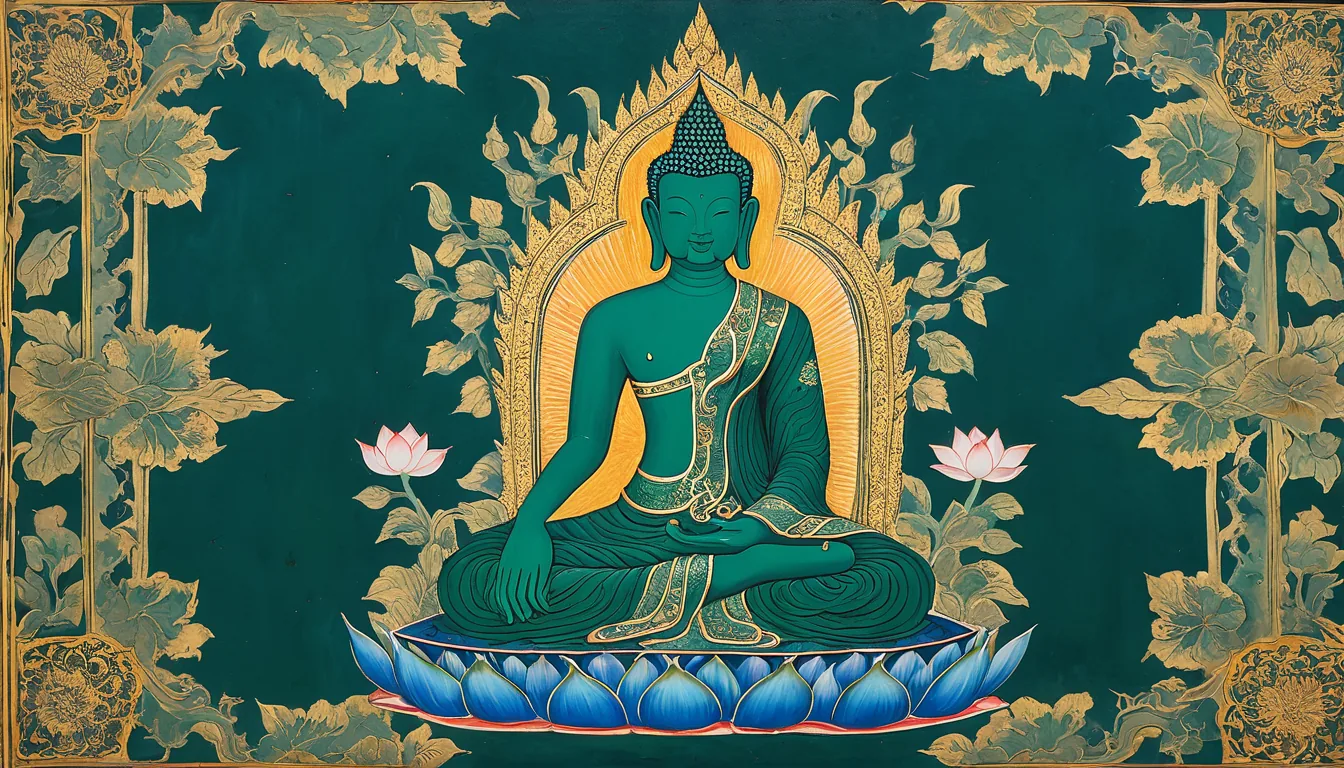
The Emerald Buddha (Thai: พระแก้วมรกต, Phra Kaew Morakot; formal name พระพุทธมหามณีรัตนปฏิมากร, Phra Phuttha Maha Mani Rattana Patimakon) is a seated, meditating Buddha image about 66 cm tall. It is carved from green stone and kept in the ordination hall of Wat Phra Si Rattana Satsadaram (Wat Phra Kaew) in Bangkok's Grand Palace [1], [2]. It is not made of emerald. The word refers to its colour, and the stone has never been tested [1], [4]. Its documented history begins in Chiang Rai in 1434, and it has been in Bangkok since the 1780s [1], [3].
Key facts
| Fact | Detail | Source |
|---|---|---|
| Thai names | พระแก้วมรกต (Phra Kaew Morakot); พระพุทธมหามณีรัตนปฏิมากร | [1], [2] |
| Size | About 66 cm high and about 48 cm wide across the lap | [1], [2] |
| Material | Green stone, described as jade or jasper; never tested | [1], [4] |
| Posture | Seated in meditation (ปางสมาธิ), right leg over left | [1], [2] |
| First documented | Chiang Rai, 1434, found inside a chedi after a lightning strike | [1], [5] |
| Home since the 1780s | Ordination hall of Wat Phra Si Rattana Satsadaram, Grand Palace, Bangkok | [1], [3] |
| Seasonal attire | Three sets (hot, rainy, cool), changed three times a year by the King | [1], [7] |
| Current attire sets | Made new for the 1996 Golden Jubilee; the originals are kept in the temple museum | [1], [2], [7] |
What is the Emerald Buddha made of, and how big is it?
The image is carved from a single piece of green stone [4]. English and Thai reference works call it jade or jasper, and Thai Wikipedia calls it nephrite [1], [2]. Gemmologist Richard W. Hughes notes that writers have suggested jasper or jadeite, but the image "has never been tested" [4]. Any specific mineral name is therefore an opinion, not a laboratory result.
It stands about 66 cm tall; Thai Wikipedia gives a lap width of 48.3 cm [1], [2], while Hughes gives about 42 cm [4]. The Buddha sits in meditation with the right leg over the left. Art historians place its style in the late Chiang Saen or Chiang Mai school, probably not much earlier than the 15th century CE [1]. Thai Wikipedia describes the style as pre-Chiang Saen to Chiang Saen and notes that King Mongkut (Rama IV) considered an Indian origin unlikely and a Lanna origin more credible [2]. Morakot (มรกต), the Thai word for emerald, refers to its green colour rather than the mineral [1].
The legend of the Emerald Buddha, as told in the chronicles
The traditional origin story comes from Buddhist chronicles, chiefly the Ratanabimbavamsa (Chronicle of the Emerald Buddha), the Jinakalamali and the Amarakatabuddharupanidana [1], [3]. Written in Pali in the 15th century by Brahmarājaprajña, the Ratanabimbavamsa survives in a manuscript dated 1788 [1]. Michel Lorrillard dates the Amarakatabuddharupanidana to the third quarter of the 16th century [1]; George Cœdès and Robert Lingat argued its anonymous author probably came from Vientiane [3]. Camille Notton published an English translation, The Chronicle of the Emerald Buddha, in Bangkok in 1931 [3].
The chronicles tell the following legend (reported here as chronicle narrative, not historical fact):
- Creation. In the chronicles, the monk Nagasena wished to make a Buddha image from a magic jewel at Pataliputra (modern Patna) about 500 years after the Buddha's death [1], [2], [3]. English Wikipedia names Vishnu and Indra and dates this to 43 BCE [1], while Thai Wikipedia and Rod-ari name Indra and the divine craftsman Vishnukamma, who carved it in the Deva heaven in 44 BCE [2], [3].
- Prophecy. Nagasena predicted the image would bring prestige to Buddhism in five lands: Lankadvipa (Sri Lanka), Ramalakka (Cambodia), Dvaravati (central Thailand), Chiang Mai and Lan Chang (Laos) [1], [3].
- Travels. Taken to Anuradhapura in Sri Lanka in 257 CE, the image was later sent towards Pagan for King Anawrahta but reached Angkor instead, then passed through Ayutthaya and Kamphaeng Phet before Chiang Rai [3].
Historians treat the pre-15th-century narrative as legend. In a 2009 paper in Explorations, art historian Melody Rod-ari writes that the journeys to India, Sri Lanka, Burma and Cambodia lack archaeological or epigraphic support and served to link the image—and its royal keeper—to major Buddhist centres [3]. Thai Wikipedia adds that the chronicle accounts before Chiang Rai contain chronological contradictions—for instance placing King Milinda (Menander I, who ruled at Sagala in BE 378–413) at Pataliputra in BE 500—and are likely later fabrications [2].
Documented history: from Chiang Rai to Bangkok
From 1434 onwards, the image's movements connect to dated events and cities.
Chiang Rai, 1434: the discovery
In 1434 (BE 1977), lightning struck the chedi of Wat Pa Yia (also spelled Pa Ya or Pa Yea) in Chiang Rai [1], [2], [5]. Inside the collapsed stupa was a stucco-covered Buddha; when stucco flaked off the nose, green stone showed beneath [1], [5]. The temple later became Wat Phra Kaew [5].
Lampang: the elephant story
When King Sam Fang Kaen of Lan Na ordered the image brought to Chiang Mai, the elephant carrying it three times turned towards Lampang instead. Taking this as a sign, he left the image in Lampang for about 32 years at what is now Wat Phra Kaew Don Tao [1], though Thai Wikipedia notes accounts vary [2].
Chiang Mai, 1468
In 1468 (1481 in one chronicle cited by Rod-ari), King Tilokaraj moved the image to Chiang Mai and placed it in the great chedi at Wat Chedi Luang [1], [2], [3]. It stayed in Chiang Mai for about 84 years [3]. Citing historian Frank Reynolds, Rod-ari notes that seasonal costumes for the image may already have existed in mid-15th-century Chiang Mai [3].
Luang Prabang and Vientiane
Invited to take the vacant throne of Lan Na, Crown Prince Setthathirath of Lan Xang (พระเจ้าไชยเชษฐา, Chai Chettha) later became king of Lan Xang and carried the image to Luang Prabang [1]. Moving his capital to Vientiane, he built Haw Phra Kaew in 1565–1566 to house it, where it remained for over 200 years [1], [6].
Thonburi and Bangkok
In 1778 or 1779, Thonburi forces under General Chao Phraya Chakri took Vientiane and brought the image to Thonburi, placing it in a shrine near Wat Arun [1], [2], [3], [5], [6]. In 1782, Chao Phraya Chakri became King Rama I, moved the capital across the river to Bangkok, and began building Wat Phra Kaew for the image [1], [3]. Vientiane's Haw Phra Kaew was rebuilt in 1816, razed by Siamese forces in 1828, and rebuilt under French rule in 1936–1942 as a museum [6].
| Period | Place | Key event | Source |
|---|---|---|---|
| 1434 | Chiang Rai | Found inside a chedi struck by lightning | [1], [5] |
| c. 1434–1468 | Lampang | Kept at Wat Phra Kaew Don Tao for about 32 years | [1] |
| 1468 (or 1481) | Chiang Mai | Placed at Wat Chedi Luang by King Tilokaraj | [1], [2], [3] |
| 1552 (BE 2091 / 1548; or 1522) | Luang Prabang | Taken by Setthathirath | [1], [2], [3] |
| 1564 (or 1560, 1570) | Vientiane | Moved with the Lao capital; Haw Phra Kaew built 1565–1566 | [1], [2], [3], [6] |
| 1778 or 1779 | Thonburi | Brought from Vientiane; placed near Wat Arun | [1], [2], [3], [5] |
| 1784/1785 | Bangkok | Enshrined at Wat Phra Kaew | [1], [3] |
Why do sources give different dates?
Chronicles and calendar conversions produce slightly different dates across sources. For the Bangkok enshrinement, many older works and Hughes give 22 March 1784 [4], Rod-ari gives 1784 [3], and English Wikipedia cites a Fine Arts Department study dating the move to 28 February 1785 [1].
Lao dates likewise vary: English Wikipedia gives 1552 for Luang Prabang and 1564 for Vientiane [1], Thai Wikipedia gives BE 2091 (1548) and BE 2103 (1560) [2], and Rod-ari gives 1522 and 1570 [3]. Similarly, Vientiane's capture is dated to 1778 by Rod-ari and the Chiang Rai temple history [3], [5], and 1779 by the main Wikipedia articles [1], [2], [6].
Wat Phra Kaew: the temple built for the Emerald Buddha
The temple's formal name is Wat Phra Si Rattana Satsadaram (วัดพระศรีรัตนศาสดาราม). It stands inside the Grand Palace on Na Phra Lan Road in Bangkok's Phra Nakhon district [2], [10], [14]. Rod-ari describes it as both a royal chapel and a Buddhist temple. Unusually for a Thai temple, it has no permanent living quarters for monks [3].
The image sits high on a tiered throne in the ordination hall (ubosot) [3]. Rod-ari writes that King Rama III added the five-tiered throne, which represents the five peaks of Mount Sumeru [3]. He also added two large crowned Buddha images on either side, named after the first two Chakri kings [3]. Murals around the image show the Traiphum (Three Worlds) cosmology, the Jataka tales and the life of the Buddha [3].
Two other historical customs are recorded. In the early Bangkok period, the image was carried in procession during outbreaks of plague and cholera. King Mongkut (Rama IV) ended the practice because he feared it would damage the image and held that disease is caused by germs [1]. On Chakri Day, 6 April, the royal family, the prime minister and officials pray at the temple [1].
The Grand Palace's official site lists opening hours as 8:30 am to 4:30 pm daily (accessed 21 October 2026) [14].
Emerald Buddha costume change: the three seasonal robes
The image has three sets of gold attire (เครื่องทรง), one for each Thai season: hot, rainy and cool [1], [2]. King Rama I commissioned the hot-season and rainy-season sets, and King Rama III (Nangklao) added the cool-season set [1], [3], [7].
What each season's attire looks like
| Season | Approx. period | Main elements | Source |
|---|---|---|---|
| Hot (ฤดูร้อน) | about March to August | Stepped, pointed crown, breast pendant, sash, necklace, armlets and bracelets in enamelled gold with precious stones | [1] |
| Rainy (ฤดูฝน) | about August to November | Pointed headpiece of enamelled gold set with sapphires; gold-embossed monk's robe draped over one shoulder | [1] |
| Cool (ฤดูหนาว) | about November to March | Gold headpiece set with diamonds; gold-mesh shawl fringed with jewels, worn over the rainy-season robe | [1] |
In the hot season, the image wears a king's regalia. In the rainy season it wears a monk's robe [1]. Rod-ari explains how scholars read the royal crowns and ornaments: they present the image as a Buddha in the guise of a universal monarch (chakkavatti) [3].
When is the Emerald Buddha's robe changed?
The attire is changed on the first day of the waning moon (แรม ๑ ค่ำ) in the 4th, 8th and 12th lunar months. These fall around March, July or August, and November [1], [2], [7]. Thai Wikipedia adds that in a year with an extra lunar month (ปีอธิกมาส), the rainy-season change moves to the second 8th month. It then falls on the first day of Buddhist Lent [2].
Recent ceremonies reported in the Thai and English press:
| Date | Change | Source |
|---|---|---|
| 9 November 2022 | Rainy to cool season | [9], [10] |
| 14 March 2025 | Cool to hot season | [8] |
| 4 March 2026 | Cool to hot season | [7] |
| 30 July 2026 | Hot to rainy season | [11] |
How the ceremony is performed
Press reports describe a set sequence. The King climbs up to the image, offers garlands and removes the outgoing season's crown [8], [11]. He pours water over the image from a conch shell, wipes the image with a white cloth, and places the new season's crown [8], [9], [11]. According to English Wikipedia, an attendant changes the remaining garments [1].
Afterwards, the water is squeezed from the cloth into a glass bowl as lustral water [8], [9]. The King presents Nam Sang Nakhon water to members of the royal family and sprinkles the lustral water on officials inside the hall and the public outside [7], [8], [10], [11]. Brahmin officiants then perform a candle-circling rite (wian thian) [8], [11].
The 1996 Golden Jubilee attire sets
The attire seen today was made in the 1990s by the Bureau of the Royal Household, the Treasury Department and other agencies to mark King Bhumibol Adulyadej's Golden Jubilee in 1996 [1], [7]. Thai Wikipedia gives the timeline [2]:
- Royal permission was granted on 26 September 1995, and work began in October 1995.
- The cool-season set was presented on 25 November 1996.
- The hot-season set was presented on 23 March 1997, and the rainy-season set on 20 July 1997.
English Wikipedia states the new sets were funded entirely by donations, while Thai Wikipedia notes that the public was invited to donate towards the cost [1], [2]. The original sets are kept in the Museum of the Emerald Buddha Temple in the Grand Palace [1], [2]. Thai Wikipedia gives these weights for the new sets [2]:
| Set | Gemstones (pieces) | Gold, net (g) | Total weight (g) |
|---|---|---|---|
| Cool | 15,868 | 5,579.50 | 6,179.87 |
| Hot | 6,297 | 7,145.00 | 7,737.80 |
| Rainy | 15,388 | 7,913.84 | 8,206.38 |
Replicas and amulets made in the Emerald Buddha's image
The Emerald Buddha is widely reproduced across Thailand as full-size copies, altar images and commemorative coins.
Phra Yok Chiang Rai: the jade replica
Wat Phra Kaew in Chiang Rai keeps a close copy called Phra Yok Chiang Rai (Chiang Rai Jade Buddha), commissioned in 1990 for the 90th birthday of the Princess Mother, Somdet Phra Srinagarindra [5]. Carved in China from Canadian jade, it measures 48.3 cm across the lap and 65.9 cm high—deliberately 0.1 cm shorter than the original [5]. Dedicated in Bangkok on 20 September 1991 and taken in procession to Chiang Rai on 19 October 1991, it sits in the Haw Phra Yok, which opened in 1998 [5].
The BE 2475 (1932) Emerald Buddha coin
Komchadluek reported in 2022 on an Emerald Buddha coin struck in gold, nickel and copper at the Royal Mint for the 150th anniversary of Rattanakosin (Bangkok) in BE 2475 (1932) [13]. Its front shows the Emerald Buddha on a lotus base within a ruean kaew arch (ซุ้มเรือนแก้ว), and it was consecrated at a major ceremony attended by prominent monks from across the country [13].
The BE 2525 (1982) bicentennial coin
For the 200th anniversary of Rattanakosin in BE 2525 (1982), a coin was struck with the Emerald Buddha on the front and the royal cypher ภปร on the back, known to collectors as Phra Kaew Morakot lang Por Por Ror (พระแก้วมรกตหลัง ภปร) [12]. A 2026 Daily News amulet column featured a gold example showing the image in hot-season attire from the first issue, first die (รุ่นแรกบล็อกแรก) [12].
What collectors look at
Thai amulet columns identify these commemorative coins by the state occasion and year, the metal, the reverse inscription or royal cypher, and, for the 1982 issue, the seasonal attire and die block [12], [13].